


What to Put in a Holiday Home Guest Welcome Book
A useful holiday home guest welcome book puts the information people need during the stay in one predictable place. Start with the address, arrival and access steps, Wi-Fi, the few house rules that prevent problems, instructions for unfamiliar equipment, emergency contacts, and a short departure checklist. Then add parking, rubbish and recycling, local services, and genuinely useful recommendations.
For a home shared by family, friends, siblings, or trustees, the book needs one extra layer: every section should have an owner and a review date. That stops three co-owners from sending different instructions and prevents an old lockbox code, closed restaurant, or changed bin day from lingering in the binder.
Use the template below to build a printed house binder, a digital guide, or both. If you want a ready-made starting point, the free holiday home guest welcome book generator creates a clean version from only the sections you complete.
Keep the group's broader owner and provider details in a separate shared holiday home contact directory. Copy only the current hosting, backup, maintenance-reporting, and locally verified emergency contacts that an invited guest needs for that stay.
Guest welcome book, house manual, or property information pack?
These names usually describe the same practical resource:
- guest welcome book or welcome pack in many holiday-home settings;
- house manual when the focus is on how the property works;
- property information pack when access, contacts, and services matter most;
- holiday house guide in Australia;
- cabin or cottage binder in Canada and the United States;
- bach book in New Zealand.
This guide is for a privately shared home used by co-owners and their invited family or friends. It is not a guide to operating a holiday rental. If you accept paying guests, follow the accommodation, fire-safety, privacy, insurance, tax, and licensing rules that apply where the property is located.
The 12 sections worth including
Put urgent, stay-critical information before recommendations. Someone arriving after dark should not have to pass three pages of restaurant suggestions to learn which gate to use.
| Section | Include | Leave out |
|---|---|---|
| 1. Property address | Full address, property name, and a map pin if the address is unreliable | Long history of the home |
| 2. Arrival | Check-in window, first parking step, and lights or utilities to turn on | Instructions that only a co-owner can perform |
| 3. Access | Which door, key or lockbox location, gate sequence, and key return | Permanent codes in a widely shared public document |
| 4. Wi-Fi | Network name and current password | Router administrator credentials |
| 5. Parking | Permitted spaces, access constraints, and an overflow plan | Vague advice such as “park nearby” |
| 6. House rules | The five or six rules a guest must act on | The full co-ownership agreement |
| 7. Appliances | Only non-obvious controls and common failure points | Copied manuals for every device |
| 8. Heating and cooling | Normal settings, simple controls, and who to contact | Unsafe repair instructions |
| 9. Rubbish and recycling | Bin location, collection day, sorting, and food-waste steps | Out-of-date collection calendars |
| 10. Local services | Grocery, pharmacy, fuel, transport, and a useful trades contact | A directory of every nearby business |
| 11. Emergency information | Property address, local emergency number, evacuation basics, and responsible contact | Unsupported medical or rescue advice |
| 12. Departure | Keys, locks, rubbish, laundry, thermostat, and issue reporting | An unrealistic deep-cleaning marathon |
A one-page minimum version
If the complete guide is not ready, publish a one-page version first:
- property name and full address;
- arrival, parking, and access;
- Wi-Fi;
- who to contact;
- three essential house rules;
- departure time and key return;
- local emergency number and where to find the full emergency plan.
That page solves the highest-frequency questions without delaying the whole project. Add the remaining sections only when the details have been checked.
Write for someone who has never visited
Co-owners often skip steps because the home is familiar to them. A guest does not know that “the usual entrance” means the side door beyond the shed, or that the television only works after a separate wall switch is turned on.
Use instructions that another person can test:
Too vague: Park at the back and use the spare key.
Useful: After the green gate, use the second gravel space on the left. The entry key is in the lockbox beside the side door. Return it to the same box when leaving.
Too vague: Leave the house tidy.
Useful: Put rubbish in the outside bins, load used towels into the laundry basket, close the bedroom windows, return the key, and message the hosting owner about breakages or low supplies.
Keep each instruction to one action where possible. Use descriptive headings, numbered steps for sequences, and bullets for checks. Photos help with an unusual gate, utility control, or appliance, but include a text explanation so the instruction still works when an image does not load or cannot be interpreted.
Separate guest instructions from co-owner decisions
A welcome book explains what a guest needs to do. It should not become the only record of how owners govern the home.
Keep these in the guest book:
- where guests may park;
- which rooms or cupboards are private;
- pet, smoking, noise, and occupancy expectations;
- what to do if something breaks;
- what must be completed before departure.
Keep voting thresholds, owner contributions, booking priority, reimbursement rules, and dispute processes in the owners' operating rules. The holiday home house rules guide helps turn those decisions into guest-facing expectations without exposing the group's financial or legal documents.
The distinction matters when owners host different groups. A guest should receive one approved answer, even if the owners debated several alternatives before agreeing it.
Keep the earlier approval step in a shared holiday home guest request. That record applies the current policy to one proposed stay and links its dates, responsible owner, decision, access window, guide version, and close-out; the welcome book begins after approval and contains only the instructions the invited party needs.
Make access information useful without oversharing it
Access instructions are usually the most sensitive section. Treat them differently from local recommendations:
- share them only with people who need them for the stay;
- avoid putting permanent access codes in a public link;
- state when temporary codes begin and expire, if the lock supports that;
- keep router administration details out of the Wi-Fi section;
- update the guide immediately after a lost key or exposed code;
- make one owner responsible for approving access changes.
A printed binder inside the home cannot help someone who is still outside. Send the arrival and access page before the stay, then keep a complete copy inside for reference. If several owners send pre-arrival messages, nominate the hosting owner to send the final approved version.
Keep the owner-side lifecycle in the shared holiday home key and access register. That record should show who may issue, hold, test, return, revoke, or replace an approved method and where the controlled detail lives; the guest guide should contain only the current instructions needed for the invited stay.
Include appliance instructions only where friction exists
Do not reproduce a manufacturer manual. Explain the local quirks that cause repeated calls or accidental misuse.
A strong appliance entry answers four questions:
- What is this control called?
- Where is it?
- What is the normal way to use it?
- Who should the guest contact if it does not work?
For example:
Hot water boost: The labelled switch is inside the hall cupboard. Press it once for a timed boost. If the indicator does not light, contact the hosting owner; do not open the electrical panel.
Prioritise induction hobs, heating controls, fireplaces, septic or water limitations, pool or spa controls, alarms, television inputs, laundry equipment, and anything that behaves differently from a typical home. Follow manufacturer instructions and use qualified professionals for safety-critical systems.
Keep equipment records, replacement dates, and supplies in a separate shared holiday home inventory. The guest guide should explain how to use an item safely, not become the ownership group's asset register.
Keep the emergency section local and verified
Emergency information must match the property and jurisdiction. At minimum, include:
- the full address in a format that can be read to a dispatcher;
- the local emergency number;
- the hosting owner or responsible local contact;
- the agreed evacuation meeting point;
- where to find first-aid supplies and the full emergency plan;
- how to report a non-urgent maintenance problem.
Ready.gov's planning guidance recommends deciding how people will receive alerts, evacuate, communicate, and reconnect. Use the equivalent official emergency-management guidance for the country, state, province, territory, or council where the home is located.
The welcome book is a quick reference, not a substitute for working alarms, compliant safety equipment, an evacuation plan, local warnings, manufacturer instructions, or professional advice. Follow the holiday home emergency information sheet guide to verify each field, then use the free generator to prepare the visible copy.
Curate local recommendations instead of building a directory
Recommendations earn their space when they answer a question a generic map result cannot.
Useful details include:
- the closest grocery shop that is open after the usual arrival time;
- where to buy fuel, firewood, or essential supplies;
- which café works with children or a large group;
- whether a beach, trail, or market has access constraints;
- where parking becomes difficult;
- seasonal closures or booking requirements;
- the date the recommendation was last checked.
Limit the first version to a few dependable choices. The existing guide to sharing useful local knowledge can help owners collect recommendations, but the welcome book should surface only the ones a guest can act on quickly.
Use a short departure checklist
A departure checklist protects the next stay when it is realistic enough to be completed. Group it by sequence:
Before packing the car
- return shared items to their labelled places;
- put used towels or linen in the agreed location;
- check the refrigerator for personal food;
- report damage, low supplies, or a maintenance problem.
Before closing the door
- follow the agreed rubbish and recycling steps;
- set heating or cooling to the approved away setting;
- close specified windows and external doors;
- switch off only the items named in the guide;
- return keys and confirm the property is locked.
Cleaning standards belong in the wider guest-ready handover process. The welcome book should give guests the clear final checks, not hide a complete turnover schedule beneath the heading “checkout.”
Give every section an owner and review date
The hard part is not writing version one. It is preventing version one from becoming misleading.
Use a simple maintenance table:
| Section | Responsible owner | Review trigger | Routine review |
|---|---|---|---|
| Access and keys | Access coordinator | Code, lock, or key changes | Before each hosted stay |
| Appliances | Maintenance lead | Repair or replacement | Every six months |
| Rubbish and recycling | Local owner | Council schedule changes | Each season |
| Emergency information | Safety lead or local contact | Official guidance or contact changes | At least twice a year |
| Local recommendations | Rotating owner | Closure or poor guest feedback | Each season |
| Departure | Operations lead | Repeated missed handover step | After the first three uses |
Add “last reviewed” to the document and keep one approved master. Co-owners can suggest changes, but one person should publish them. Archive replaced versions so nobody unknowingly reprints an obsolete copy.
Digital, printed, or both?
For most shared holiday homes, use both:
- a digital version for pre-arrival access, remote updates, and phone use;
- a short printed version inside the home for poor reception, a flat phone battery, or guests who prefer paper.
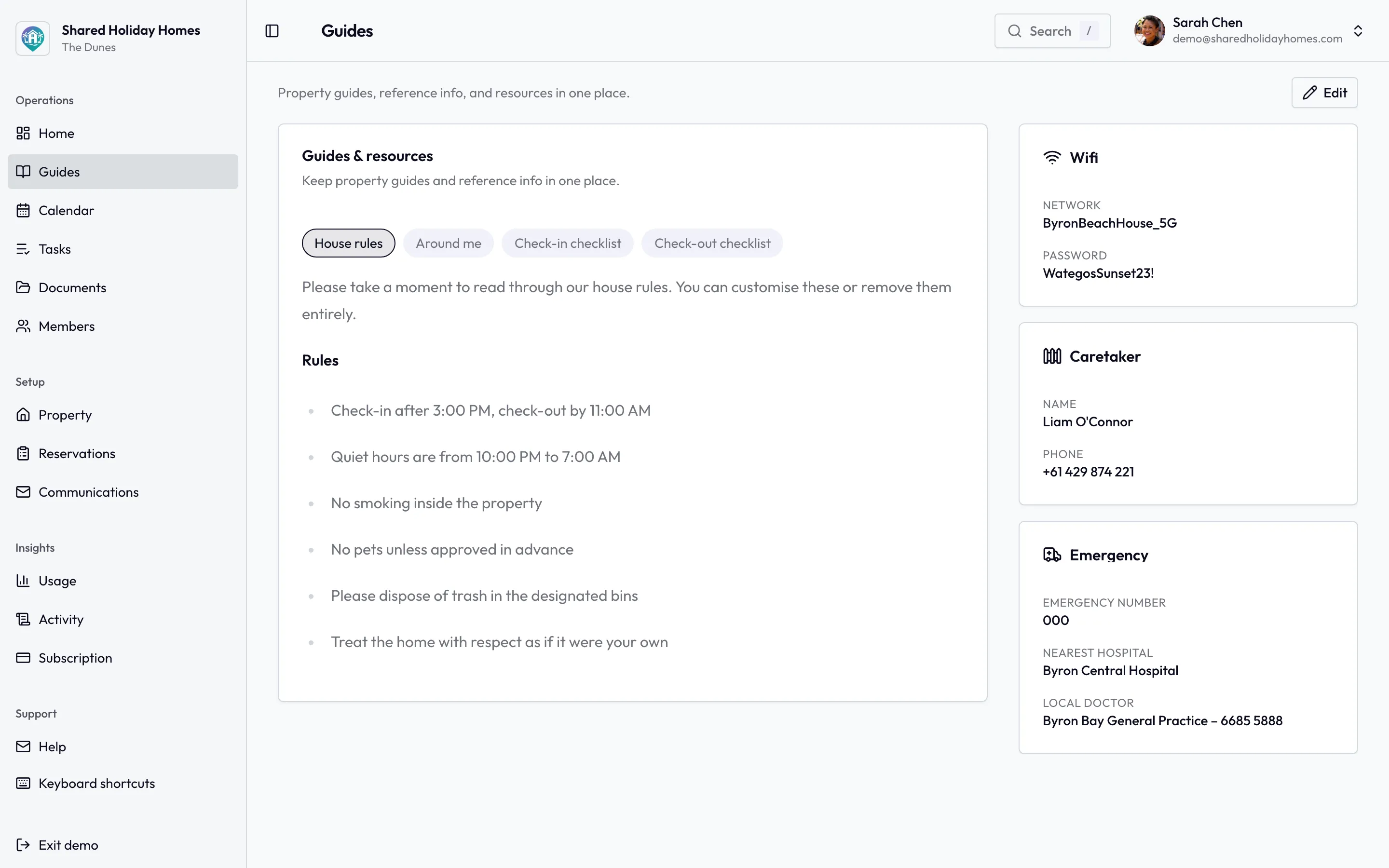
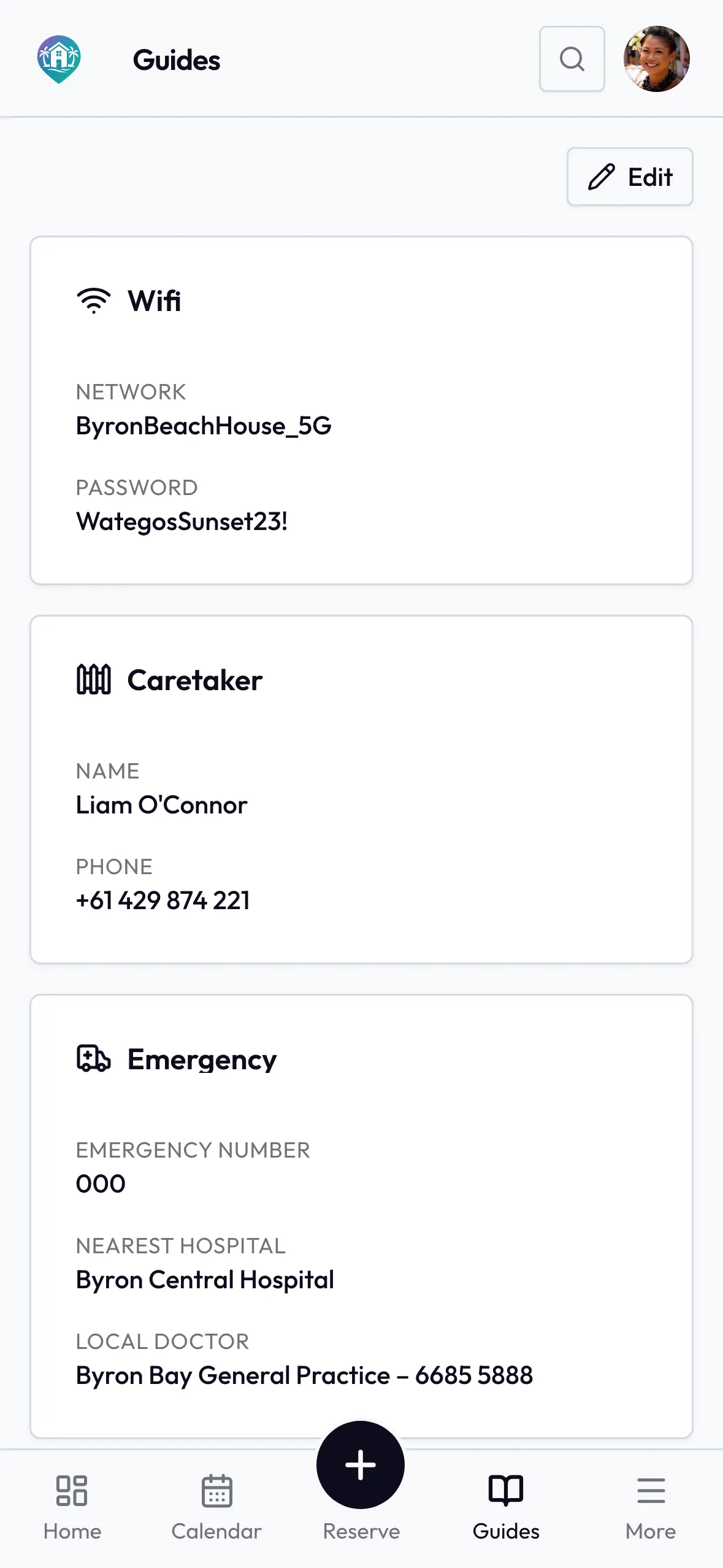
Keep one approved digital master that phones can open before arrival, then print a short dated copy for the house.
The printed copy should show its review date and point to the approved digital version. When an important detail changes, update the master first, replace the printed page, and tell owners which version is current.
Avoid sending editable copies to every owner. That creates multiple “final” documents. A single master with a clear update owner is more reliable than a beautifully designed file scattered across inboxes and group chats.
Build your first version in 30 minutes
- Ask each owner for the questions their guests repeatedly ask.
- Open the guest welcome book generator.
- Complete address, arrival, access, Wi-Fi, emergency, and departure first.
- Add only the house rules and appliance notes that require action.
- Ask someone unfamiliar with the home to test the instructions.
- Correct ambiguous steps and remove unnecessary detail.
- Assign an owner and review trigger to each section.
- Publish one approved digital version and one dated printed copy.
Do not paste live access details into a planning document shared beyond the owner group. Add sensitive fields only when the final storage and sharing method is appropriate.
FAQ
What is the difference between a guest welcome book and a guest book?
A guest welcome book is an instruction guide for the stay. A guest book is usually a visitor log where people leave names, dates, or memories. Keep them separate so essential property information is easy to find.
How long should a holiday home welcome book be?
Make the first page useful on its own, then keep each topic short enough to scan. Length matters less than structure: clear headings, one subject per section, and urgent information first. Remove background material that does not change what the guest should do.
Should the Wi-Fi password be on the first page?
It should be easy to find, but not in a version that is publicly accessible. Put it near the front of the private guest copy and keep router administration credentials elsewhere.
Who should update a welcome book for a co-owned home?
Assign one publisher and a responsible owner for each section. Any co-owner can flag a change, but one approved master prevents contradictory copies.
Should a welcome book include house rules?
Yes, but include only the rules a guest needs to follow. Keep ownership voting, expenses, and legal arrangements in the owners' documents.
Can the free generator make a shared live guide?
The free generator creates and exports a guide in one browser. It does not synchronise edits between co-owners. Shared Holiday Homes property guides are designed to keep shared property information available to the owner group.
Keep the guide current across the owner group
A welcome book works when it answers the next question with the current answer. Start with the free holiday home guest welcome book generator, test it with someone new to the property, and assign the update responsibilities before printing.
When your group wants bookings, tasks, documents, and property guides in one shared place, start a Shared Holiday Homes trial. The goal is not a longer binder. It is a calmer arrival and one reliable version of how the home works.


