

Shared Holiday Homes vs CabinPals for Shared Cabin Co-Ownership
If you co-own a cabin with family or friends, the hard part is rarely the building. It is stays, chores, money, and house knowledge. CabinPals and Shared Holiday Homes both aim at that operating layer. Neither is a generic calendar dressed up as co-ownership software.
CabinPals leans cabin-first: one place for stays, task ownership, and shared costs so the group text stops being the booking desk. Shared Holiday Homes covers holiday homes more broadly — cabins included — with a shared calendar, booking rules, tasks, documents, and house guides for private co-owner groups.
This comparison is meant to help you choose honestly. CabinPals is not “wrong.” Shared Holiday Homes is not required for every cabin group. The better fit depends on whether you want cabin-focused cost tracking and a home dashboard, or a wider holiday-home layer with rules, documents, and house guides beside the calendar.
Disclosure
Shared Holiday Homes publishes this comparison. We built one of the products in it. We still describe CabinPals from its public site, and we do not invent CabinPals features, reviews, or pricing. CabinPals figures below are public signals as of the dated pricing section — verify on their site before you buy.
CabinPals is a real option for many cabin groups. Choose the tool that matches how your group actually books, maintains, and pays for the place.
At a Glance
| Need | CabinPals | Shared Holiday Homes |
|---|---|---|
| Primary focus | Cabin / shared-home groups (1–15 homes) | Holiday homes broadly, including cabins |
| Shared stay calendar | Yes | Yes |
| Double-booking friction | Shared calendar so everyone sees the same plan | Bookings with double-booking protection |
| Booking rules and peak rotations | Policy and process depend on how the group uses the calendar | Rules can sit with the calendar |
| Task ownership | Assigned chores and repairs with status | Named jobs with due dates |
| Shared cost tracking | Built into the product pitch | Pairs with a clear expense process and free cost-split calculator |
| Documents and house information | Home dashboard, local guide, providers, inventory | Document library and house guides |
| Roles and member access | Account and roles for owners, family, helpers | Property members with shared access |
| Trial / free entry | Lite free tier; Shared unlock with a short trial on their site | Paid plans with a 7-day trial; free planning tools |
For a wider calendar survey, see best shared vacation home calendar software for 2026. Use this page when the real question is CabinPals versus Shared Holiday Homes for cabin co-ownership.
When CabinPals Fits
CabinPals can be a strong fit if most of these are true:
Your group thinks of the place as a cabin first
CabinPals markets itself around shared cabin life: families, friends, and co-owners who want less group-text chaos. If that language matches how your group talks about the home, the product framing will feel natural.
You want shared cost visibility inside the same app as stays and chores
CabinPals publicly emphasises simple shared cost tracking alongside the calendar and task ownership. If reimbursements are scattered and money talks get awkward fast, that bundled pitch matters.
You like a home dashboard with inventory, providers, and local notes
Beyond stays and chores, CabinPals surfaces inventory, shopping lists, service providers, a local guide, and notifications. Groups that want those cabin-ops extras in one dashboard may prefer that shape.
You are coordinating roughly one to fifteen homes
CabinPals positions itself for groups running one to fifteen homes, with Shared and Portfolio-style plans for different scales. Multi-cabin families and small portfolios sit squarely in that story. It also publicly shows a free Lite path and a short trial when unlocking Shared, which is enough to test whether people will log in.
If that describes your group, CabinPals deserves a serious look. Switch because the workflows match how you already fight about weekends, leaks, and bills — not because of branding alone.
When Shared Holiday Homes Fits
Shared Holiday Homes can be a better fit if most of these are true:
The home is a holiday home first — cabin included
Shared Holiday Homes is built for private co-owner groups who already share a holiday home. Cabins are included, but the product is not cabin-only. That matters if your next place is a beach house or ski property, or if “holiday home ops” is closer to how you think.
Booking rules need to live with the calendar
Many cabin fights are not “who can see the calendar?” They are “who gets Christmas, how early can you book peak weeks, and what happens when someone cancels?” Shared Holiday Homes is designed so booking windows, peak rotations, and related rules can sit with stays instead of living only in a PDF or chat memory.
Documents and house guides are part of the load
Insurance PDFs, co-ownership notes, appliance manuals, arrival instructions, and WiFi details are not optional admin. Shared Holiday Homes concentrates on a document library and house guides beside the calendar and task list.
You want a clear expense method without a full finance suite claim
Shared Holiday Homes does not claim to replace a complete shared-finance stack. It pairs better with a written expense-split process and the free cost-split calculator. Use the 7-day trial to test the workspace, and free tools to decide how the group wants to run before anyone imports next summer’s bookings.
If that describes your group, try Shared Holiday Homes when the calendar alone is no longer carrying rules, documents, tasks, and house knowledge.
Real Cabin Co-Ownership Scenarios
Two households book the same long weekend
CabinPals: The product pitch centres on one shared calendar so everyone sees the same plan before travel is booked. Visibility is the main defence against accidental double weekends.
Shared Holiday Homes: Confirmed stays live in one booking calendar with double-booking protection, and groups that need more than visibility can put peak rules and booking windows on the calendar itself.
Spring opening jobs keep falling through
CabinPals: Clear task ownership is a core promise — assign chores and repairs to real people with due dates and status, so “I thought you had it” shrinks.
Shared Holiday Homes: Named maintenance jobs with due dates sit beside the property calendar. Pair that with a practical vacation home maintenance checklist for co-owners so the spring open is a dated plan, not a hopeful chat thread.
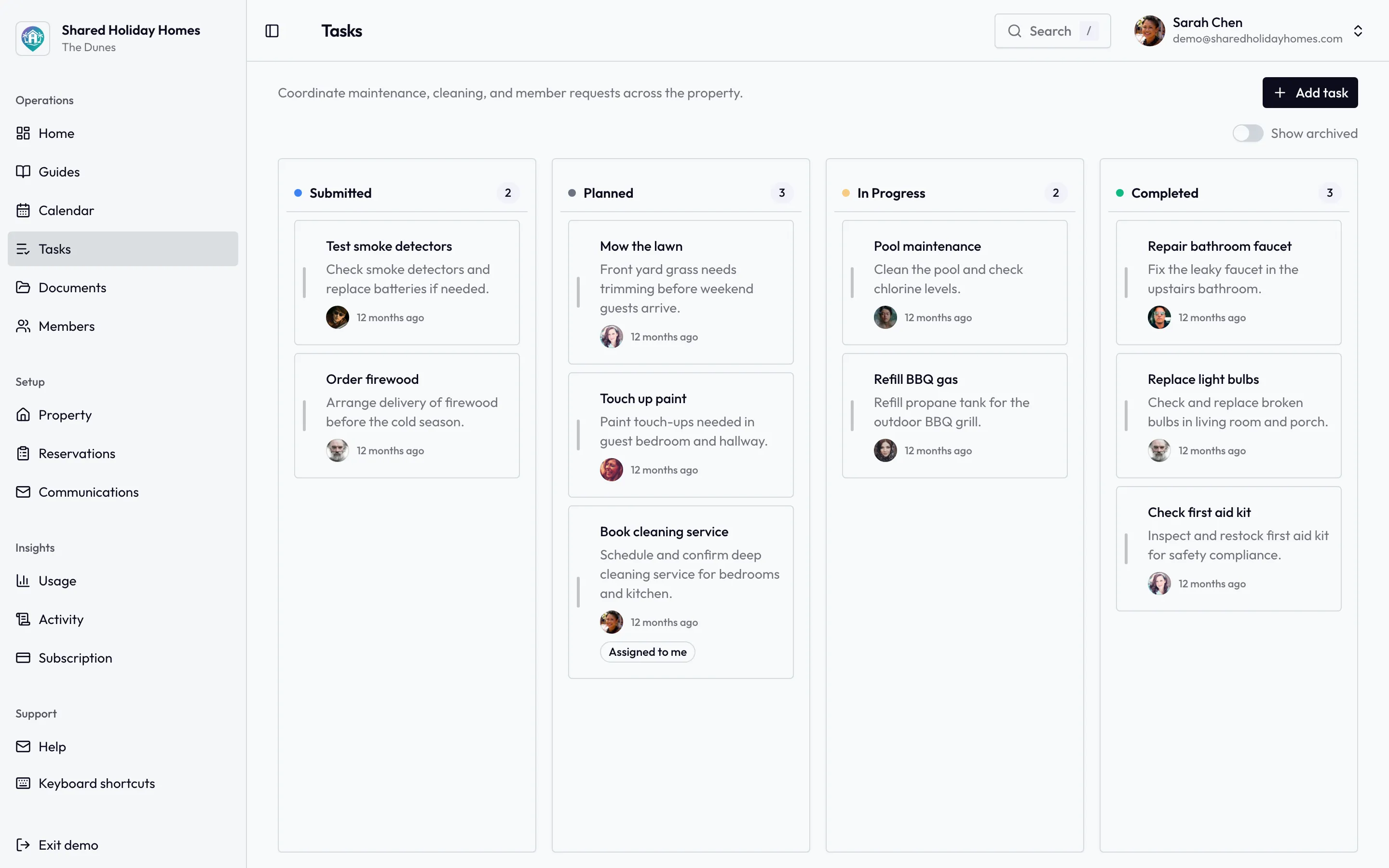
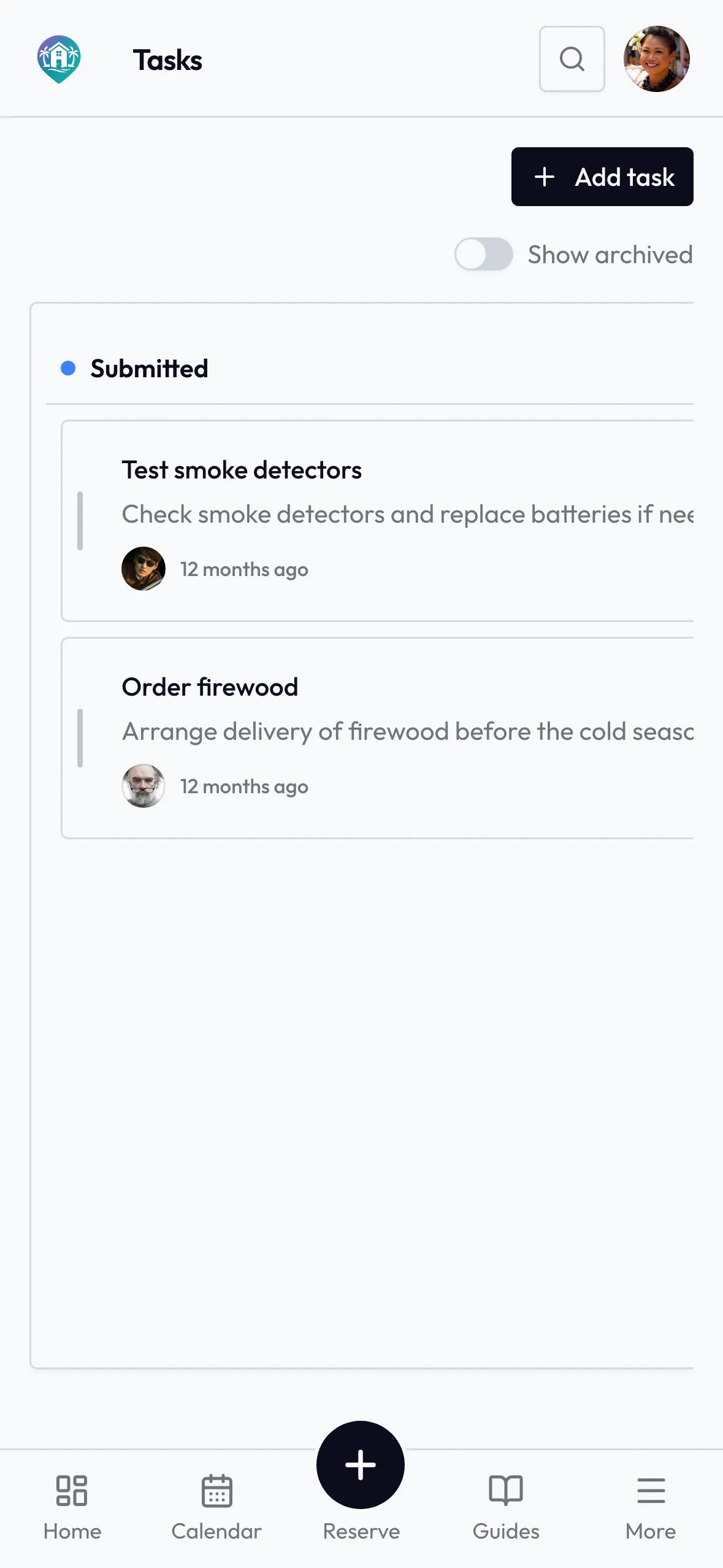
Spring opening work stays visible when jobs have owners and due dates, not just a group-text reminder.
Turnover cleaning becomes silent resentment
CabinPals: Task assignment and a shared home view can make the next clean visible. Groups that already think in chores and inventory may keep cleaning inside that dashboard.
Shared Holiday Homes: Treat cleaning as named work with owners and dates, and use a clear shared holiday home cleaning rota so the expectation is written before the next arrival.
The septic pump invoice lands and nobody agrees who owes what
CabinPals: Shared cost tracking is part of the public product story — house expenses in one place so every owner can see what was spent and why.
Shared Holiday Homes: Agree the split rules first with a documented expense process, test the numbers in the cost-split calculator, and keep the job record and supporting files with the property workspace rather than treating the product as a full finance suite.
Pricing, As of 6 August 2026
Pricing changes. Treat every figure below as a public signal to re-check, not as a quote.
CabinPals (public site as of 6 August 2026): CabinPals publicly showed about $89.99/year for its Shared plan (positioned for one active shared home), monthly billing as an alternative, and a rough monthly-style read of about $7.50 when you annualise that Shared price. Portfolio was publicly shown around $1,449/year for groups running more homes, with additional properties around $75/property/year. Shared versus Portfolio detail and signup live through their app experience at app.cabinpals.com. They also publicly showed a free Lite path and a short trial when unlocking Shared. Verify current numbers on cabinpals.com before you decide.
Shared Holiday Homes: We are not inventing a neat monthly comparison figure here. Shared Holiday Homes is a paid product with a 7-day trial, plus free planning tools such as the cost-split calculator. Check current plans during signup.
The useful money question is not “which table cell looks cheaper this week?” It is whether one avoided peak-date fight, one clearer maintenance season, or one calmer expense conversation outweighs the subscription for the households involved.
Switching Between Tools
If you move from chat and spreadsheets — or from one co-ownership app to another — do the policy work first:
- Write or refresh booking rules: peak dates, booking windows, cancellations, guests, and maintenance blocks.
- Agree the expense method in plain language before you import receipts. Start with how to split shared vacation home expenses.
- Create the property in the new tool and invite the people who actually book and maintain it.
- Enter upcoming confirmed stays so nothing falls through during the switch.
- Move the documents, house notes, provider details, and open tasks people ask for every month.
- Retire the old source of truth once everyone is using the new one. Running two live booking systems creates double updates and new conflicts.
You can still keep personal calendars for school terms and travel around cabin stays. Retire the old shared system as the group’s booking and ops source of truth, not as every calendar in everyone’s life.
FAQ
Is CabinPals only for cabins?
CabinPals markets heavily to shared cabin groups, but its public site also talks about shared-home coordination more generally. If your place is a cabin and that framing fits, it is a natural shortlist candidate. If your next home is not a cabin, compare the workflows rather than the word “cabin” alone.
Does Shared Holiday Homes replace CabinPals’ cost tracking?
Not as a like-for-like claim. CabinPals publicly centres shared cost tracking in the product. Shared Holiday Homes focuses on calendar, rules, tasks, documents, and house guides, and pairs money decisions with a clear expense process plus the free cost-split calculator.
Can a small sibling group stay on a free calendar?
Yes, many do. Both tools become more useful when double bookings, maintenance guesswork, or cost tension start costing relationships. Free entry points and short trials exist so you can test before you migrate peak season.
Which tool is better for booking fairness?
Visibility helps both ways. If your group mainly needs everyone to see the same stays, either shared calendar can reduce accidents. If you also need booking windows, peak rotations, or approvals to live with the calendar, Shared Holiday Homes is built for that layer. Write the rules first either way.
Do we need software before we fix cleaning and maintenance habits?
No. Agree the cleaning rota and maintenance checklist first. Then put the named jobs where the group already looks for stays.
Keep the cabin running without the group-text chaos
CabinPals and Shared Holiday Homes both exist because shared cabins outgrow chat threads. CabinPals is a fair choice when cabin-first cost tracking, task ownership, and a practical home dashboard match how your group works. Shared Holiday Homes is a fair choice when holiday-home bookings, rules, tasks, documents, and house guides need one private workspace — with expenses handled through a clear method rather than assumed as a full finance suite.
Start a free trial and see whether one shared place for bookings, rules, tasks, and house information removes the admin load your cabin group has outgrown. For the wider shortlist, see the 2026 shared vacation home calendar roundup.


