


Shared Holiday Homes vs SharedKey for Family Vacation Homes
If your family already shares a vacation property, the hard part is rarely finding a calendar. The hard part is keeping stays, rules, house information, and day-to-day admin in one place everyone will actually use.
SharedKey and Shared Holiday Homes both aim at that problem. SharedKey positions itself as a simple shared-property organizer for family vacation homes. Shared Holiday Homes is built around co-owner booking, house operations, and the documents and guides people keep asking for. Neither product is “wrong.” The better fit depends on how much structure your group needs beyond a shared organizer. This comparison uses publicly available SharedKey marketing and pricing as of 6 August 2026; confirm current details on each site before you decide.
Disclosure
Shared Holiday Homes publishes this comparison. We describe SharedKey from its public site and pricing page, not from a paid partnership, affiliate arrangement, or private product walkthrough. Where SharedKey’s marketing is thin, we say so instead of guessing. Sibling comparisons for other tools will sit alongside this one, including Shared Holiday Homes vs Our Shared Place and our 2026 shared vacation home calendar roundup.
At a Glance
| Need | SharedKey | Shared Holiday Homes |
|---|---|---|
| Positioning | Shared family vacation property organizer | Co-owner calendar, rules, tasks, documents, and house guides |
| Public price (as of 6 Aug 2026) | $49 USD per year per property | Paid plans priced by home size; check current plans at signup |
| Trial | 30-day free trial; no credit card claimed | 7-day free trial |
| Members and guests | Unlimited members and guests claimed | Unlimited members |
| Group calendar | Advertised | Yes, with booking-focused workflow |
| Booking rules and fairness tooling | Not the centre of public marketing | Booking rules can sit with the calendar |
| House rules, instructions, welcome materials | Advertised | House guides and related property information |
| Contacts and shared organizing | Advertised, including expense-related organizing per marketing | Tasks, documents, and house operations in one place |
| Ads | No ads claimed | Product-focused app experience |
| Hardware / smart locks | Brand cue around keys and access; do not assume lock sales without verifying | Not focused on smart-lock hardware |
For a wider view of calendar-led options, see shared holiday home calendar solutions. Use this page when you are specifically weighing SharedKey against Shared Holiday Homes.
When SharedKey Fits
SharedKey can be a sensible choice if most of these are true:
You want a simple family organizer, not a heavy operating system
SharedKey’s public positioning is clear: make shared family vacation property easy. If your group mainly needs a shared calendar, contacts, house instructions, and guest welcome materials in one light tool, that may be enough.
Price predictability matters more than deeper co-ownership rules
At the public price of $49 USD per year per property (as of 6 August 2026), SharedKey is easy to budget. Unlimited members and guests, plus a claimed no-ads experience, make it attractive for families who want to try a dedicated organizer without a complicated plan matrix.
You want a longer trial, and conflict is still low
SharedKey advertises a 30-day free trial with no credit card required. That gives time to invite relatives and load house notes. If peak weeks rarely collide and trust is high, a simple group calendar plus house materials may carry the load without a fuller co-ownership stack.
You are fine evaluating a thin marketing site
SharedKey does not publish a large public content library. That can be fine if you want a known organizer category and will judge the product itself. Just go in knowing the website will not do the whole comparison for you.
If that describes your family, SharedKey is worth a fair trial. Pay for more structure only when the organizer layer stops covering fairness, tasks, and property knowledge.
When Shared Holiday Homes Fits
Choose Shared Holiday Homes when the calendar is only part of the job and the group needs the operating layer around it.
Booking rules need to live with the calendar
Co-owned homes often need booking windows, peak handling, minimum stays, or approvals. Those decisions should not live only in a PDF nobody reopens. Shared Holiday Homes is built so rules can sit with bookings. Draft the policy first with the rules generator, then put the live version where people book.
Tasks, documents, and house guides need the same home as stays
The plumber’s number, insurance file, gutter clean, arrival notes, and WiFi details should not scatter across chat, email, and someone’s laptop. Shared Holiday Homes concentrates calendar, tasks, documents, and house guides for the people who already share the home.
Unlimited members and home-size pricing fit how you think about the property
Shared Holiday Homes supports unlimited members and prices by home size rather than a single flat figure here. Check current plans during signup. Do not choose either product from an invented monthly number in a comparison table. Free planning tools help while you sort fairness, house rules, or cost splits — see also how to manage a co-owned vacation home.
You are not shopping for smart-lock hardware
Shared Holiday Homes is not focused on smart-lock hardware. SharedKey’s brand cue around keys and access can suggest an access theme, but do not assume lock sales unless you verify them directly. Pick software for the admin and booking problem you actually have.
Real Scenarios Side by Side
Four households want the same school-holiday week
SharedKey: A group calendar and shared organizing can show the clash quickly. If your family resolves peak dates by conversation and goodwill, that may be enough. The public marketing does not centre on enforced peak rotations or approval workflows.
Shared Holiday Homes: Peak-date rules, booking windows, and related calendar controls help the outcome follow a policy the group already agreed, instead of whoever noticed the open week first.
New guests keep asking for the same arrival details
SharedKey: Guest welcome materials, house rules, and instructions are part of the advertised organizer set. For many families, that is the main win over a bare calendar.
Shared Holiday Homes: House guides keep arrival notes, appliance tips, and local information available alongside bookings and documents, so the “admin” owner is not rewriting the same message every Friday.
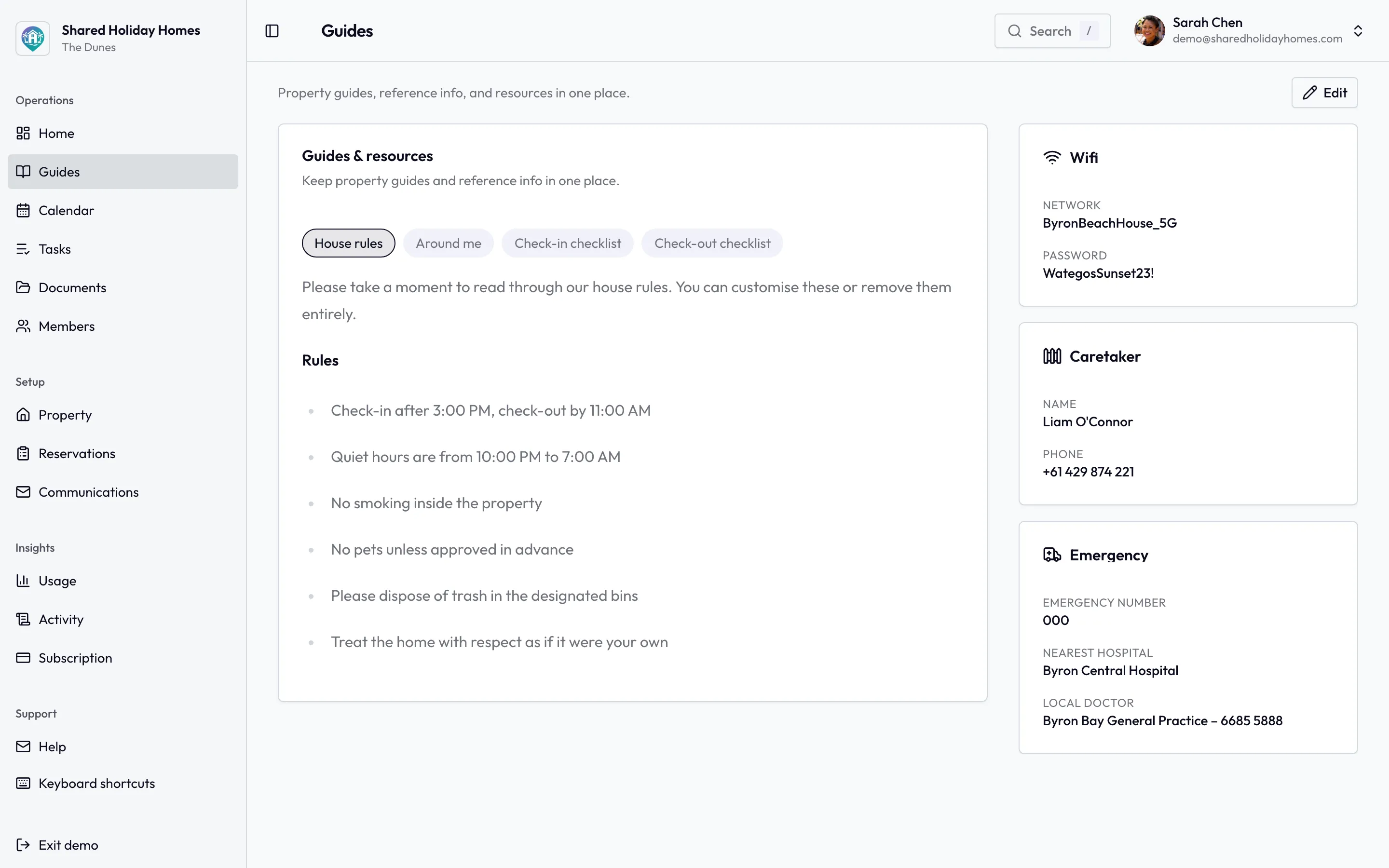
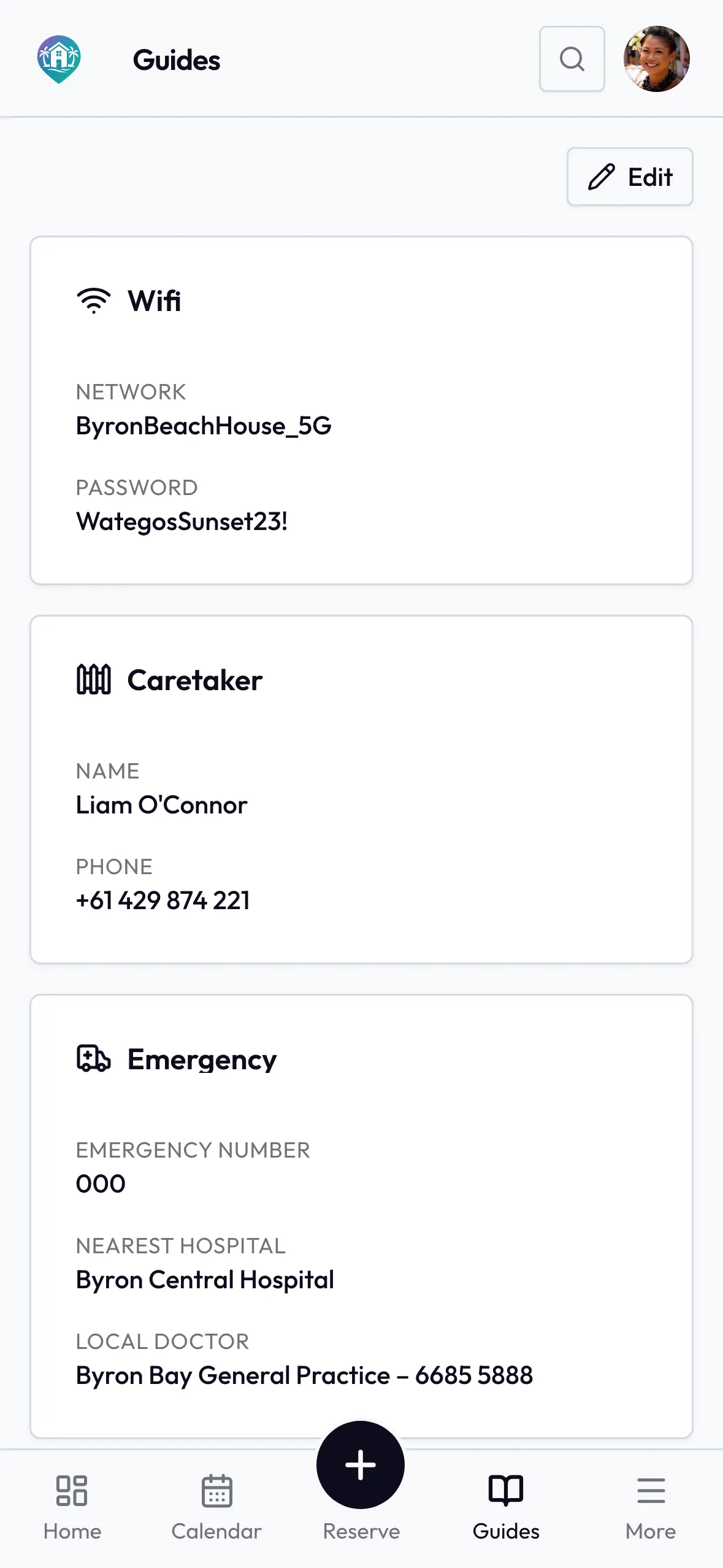
Arrival details belong in one house guide, not in a Friday message rewritten for each guest.
Maintenance jobs disappear between stays
SharedKey: Contacts and shared organizing can help keep people and notes findable. Whether recurring jobs stay visible depends on how your group uses the tool day to day.
Shared Holiday Homes: Named tasks with due dates keep the gutter clean, gas check, and bathroom leak out of chat history and attached to the property.
Year-end turns into “who used the house more?”
SharedKey: A clear shared calendar helps the conversation. Fairness counting may still need a spreadsheet or manual tally if usage tracking is not the product’s centre of gravity.
Shared Holiday Homes: Booking history and usage-oriented visibility give the meeting a shared baseline so the discussion can move to next year’s rules instead of reconstructing last year’s stays.
Someone new joins the ownership group
SharedKey: Unlimited members and a simple organizer can lower invite friction. New people still need rules, contacts, and calendar habits explained.
Shared Holiday Homes: Invite them into one property workspace with calendar, documents, tasks, and guides already in place. Point them at written house rules instead of group-chat archaeology.
Pricing and Trial Reality
SharedKey’s public price, as of 6 August 2026, is $49 USD per year per property, with unlimited members and guests, a claimed no-ads experience, and a 30-day free trial with no credit card required. That is easy to budget for families who want a dedicated organizer at a known annual cost.
Shared Holiday Homes is a paid product priced by home size, with a 7-day free trial and unlimited members. This article does not invent a Shared Holiday Homes dollar figure — check current plans at signup. Free planning tools remain available before and during evaluation.
The useful question is not “which trial is longer?” It is “what admin and conflict cost does our group carry today, and which tool reduces that cost?” A low annual fee wins when the organizer layer is enough. A purpose-built co-ownership tool wins when one avoided peak-date dispute, clearer tasks, or findable house knowledge outweighs the subscription.
Switching from SharedKey — or Trying Both Fairly
If you are already on SharedKey and considering a move, or evaluating both in parallel:
- Write or refresh the booking policy first: peak dates, guests, cancellations, maintenance blocks, and who can approve what.
- Inventory what you already use in SharedKey — calendar entries, house instructions, contacts, welcome notes — so nothing important is left behind.
- Create the property in Shared Holiday Homes and invite the co-owners.
- Enter upcoming confirmed stays so the booking source of truth does not split.
- Move the documents and house notes people actually ask for, then rebuild house guides in plain language.
- Retire the old organizer as the booking source of truth once everyone is using the new one. Running two live systems creates double updates and new conflicts.
You can still keep personal calendars elsewhere. Retire the duplicate shared booking system, not every calendar in everyone’s life.
If SharedKey still fits after a fair trial, stay. Switching tools for its own sake helps nobody.
FAQ
Is SharedKey the same kind of product as Shared Holiday Homes?
They overlap. Both target families who share a vacation property. SharedKey markets a simple shared-property organizer. Shared Holiday Homes focuses on co-owner booking plus tasks, documents, and house guides. Compare the operating load you have, not just the category label.
Is SharedKey cheap enough that we should just start there?
For many families, yes — especially at the public $49 USD per year per property price as of 6 August 2026, with a 30-day trial. Start there if needs are light. Move only when fairness, tasks, or property knowledge outgrow a simple organizer.
Does SharedKey sell smart locks?
Do not assume that from the brand name alone. SharedKey emphasises organizing a shared family vacation property, with a keys/access brand cue. Verify any hardware claims on its own site. Shared Holiday Homes is not focused on smart-lock hardware.
Can we write house rules before choosing software?
Yes. Software helps share rules; it cannot invent a fair policy. Use the rules generator and the house rules guide, then pick the tool that will host the live version.
Where else should we compare before deciding?
See the calendar solutions overview, the 2026 calendar software roundup, the sibling Our Shared Place comparison, and how to manage a co-owned vacation home so the tool follows the operating model.
Does either product replace a family conversation about fairness?
No. Tools make stays and information easier to share. They do not replace agreed rules or the willingness to follow them. Write the policy first, then choose the lightest tool that can carry it.
Keep the admin lighter
Use SharedKey if a simple, low-cost family organizer with a longer trial matches how your group already works. Choose Shared Holiday Homes when bookings need rules beside the calendar, and tasks, documents, and house guides need the same home as the stays.
Start a free trial and see whether one shared place for bookings, rules, tasks, and house information removes the admin load your family has outgrown.


