

Shared Holiday Home Room Allocation Rules
Shared holiday home room allocation rules should begin after the stay dates are approved. First map the rooms and source-led constraints. Then collect each household's minimum practical needs, apply an agreed preference and tie-break process, confirm named rooms, and recheck the plan before arrival.
Do not treat bed count, past custom, age, ownership share, or software settings as automatic proof of capacity, priority, accessibility, safeguarding, or safety. Those questions belong to the property's current governing documents, approved room inventory, insurer, applicable building or accommodation rules, local authority, and qualified advice.
This guide is for families, friends, siblings, trustees, and small groups who privately share one holiday home. It solves a narrow problem: who uses which named room or sleeping space during one already-approved overlapping stay. The vacation home booking rules guide still owns date priority and guest policy. The seasonal scheduling guide still owns peak-period access.
Separate Dates From Rooms
A booking can be fair at the date level and still become tense at the room level. Two households may share an approved week but both expect the same quiet room. A party may grow after confirmation. A room may become unavailable. Someone may need a practical feature without wanting to explain private details to the whole group.
Keep two records:
- Stay record: approved dates, booking holder, attending households, and calendar status.
- Room plan: the current source map, named-room requests, applied constraints, assignments, check time, and any reassignment.
The room plan should not reopen the approved dates. If a room issue changes who can attend, the length of the stay, or the booking holder, move that change through the group's normal process and record it in the booking change log.
Build a Current Room Source Map
Before asking for preferences, create a simple room map from current sources. Do not start with family memory or an old listing photo.
For each room or approved sleeping space, record:
- a stable room name, such as “north twin” or “ground-floor room”;
- the current room-inventory reference and review date;
- whether the room is available, unavailable, or awaiting a source check;
- the feature needed for allocation, stated factually;
- any limit or condition and the exact source that sets it;
- who can confirm a doubtful point; and
- the next review trigger.
A factual feature might be “reached without internal stairs,” “next to the shared bathroom,” or “contains two separately listed beds.” Avoid labels such as “best room,” “children's room,” “accessible room,” or “sleeps four” unless a current, appropriate source supports that description for the proposed use.
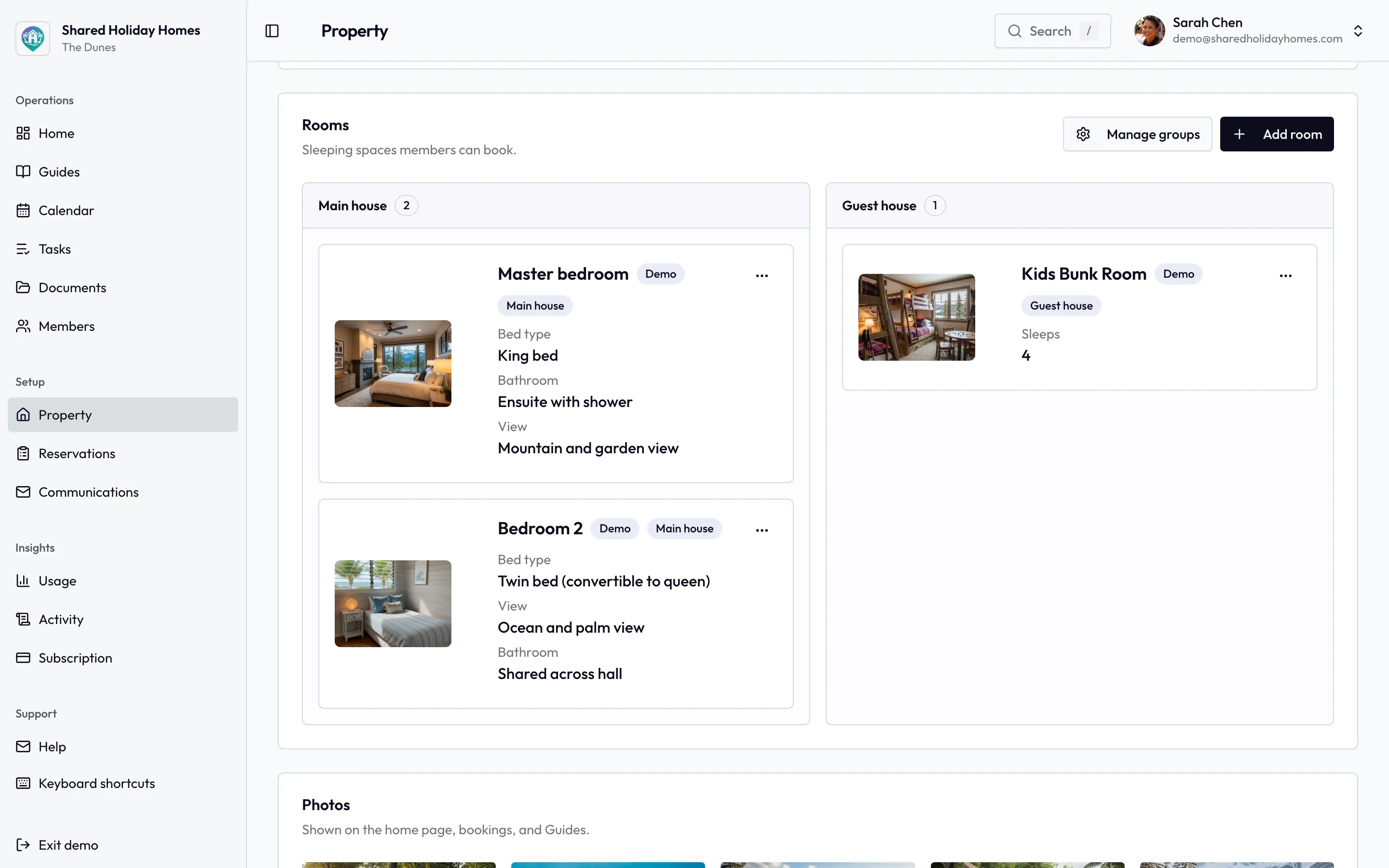
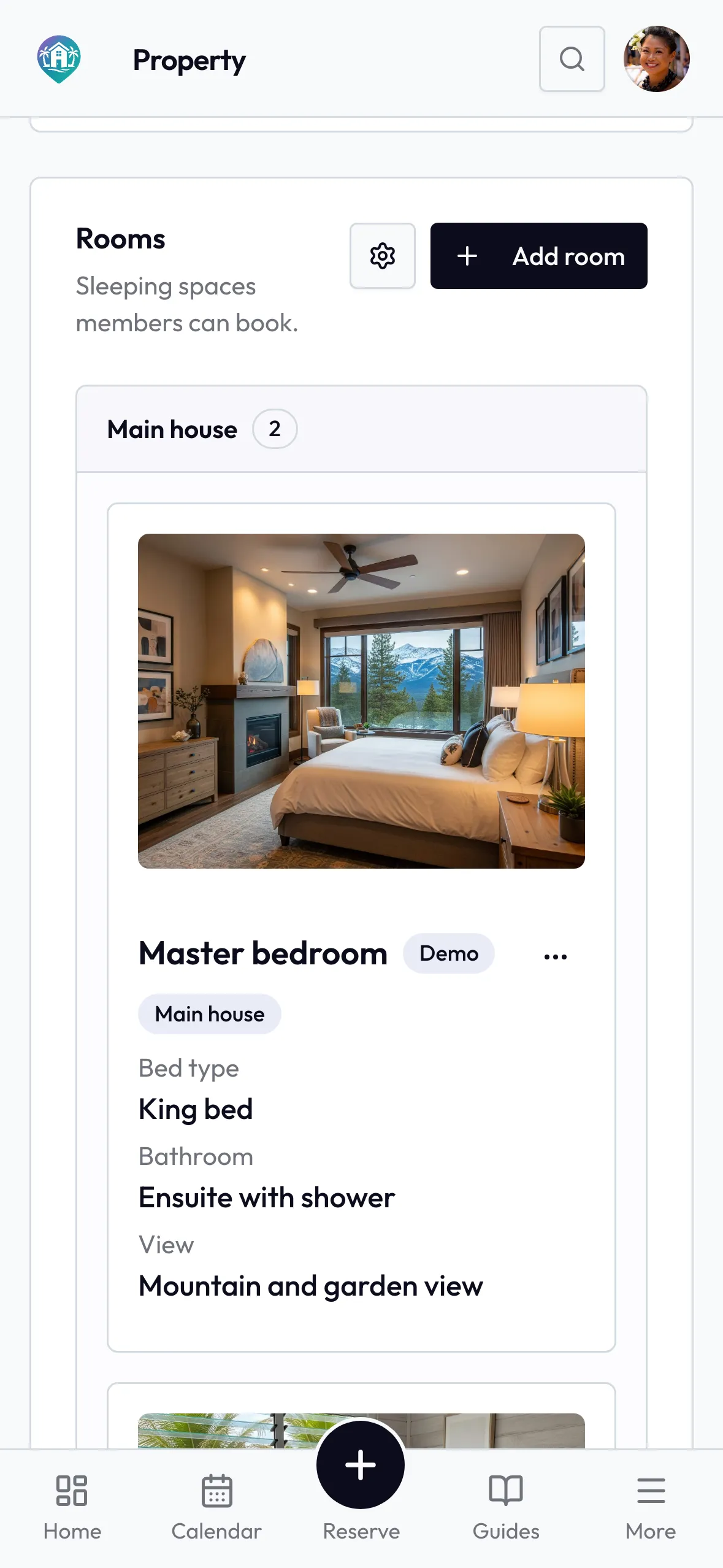
Named rooms in a current inventory are the source map. Do not allocate from family memory or an old listing photo.
| Room | Observed feature | Current source | Status | Check owner | Review trigger |
|---|---|---|---|---|---|
| Ground-floor room | No internal stairs from the main entrance | Approved room inventory R-3 | Available | Property-information owner | Layout, access route, or equipment changes |
| North twin | Two separately listed beds | Room inventory R-3 and current photos | Available | Inventory owner | Furniture or room-use change |
| Garden room | Damp mark reported after rain | Maintenance record M-27 | Checking source | Maintenance coordinator | Qualified assessment and group decision |
The rows above are fictional. They show record structure, not a capacity or safety decision. If a source is missing or unclear, mark the space checking source and obtain the right advice before assigning it.
If the home is also used as paying guest accommodation, do not assume private-use rules still cover that activity. For example, current GOV.UK guidance for small paying guest accommodation is expressly limited to relevant small premises in England and includes a fire-risk-assessment route. Use the source that actually applies to the property's location, layout, and use.
Use a Minimal Room Request
Give every attending household the same short request and deadline. Ask for the outcome needed, not a personal history.
Copy and adapt this template:
Stay reference:
Approved dates:
Attending household:
Total party size for the current source check:
Rooms requested, in order:
Practical room requirement or constraint:
Rooms that will not work, with the minimum reason needed:
Can another named room meet the same need?
Change deadline:
Private follow-up route, if needed:
Submitted by and time:
“Needs the step-free route shown in inventory R-3” is usually more useful than a diagnosis. “Needs a room away from the shared living area” is more actionable than a long explanation of sleep or family circumstances.
For groups subject to UK GDPR, the current ICO data-minimisation guidance says personal data should be adequate, relevant, and limited to what is necessary for the stated purpose. The page is currently under review following UK legislative changes, so UK groups should check it again when setting or revising their process. Other jurisdictions need their own current privacy source.
Do not copy diagnoses, medical records, children's personal details, relationship history, identity documents, travel plans, or dispute messages into a widely shared room plan. Where a private conversation is necessary, the shared outcome can often be limited to the practical constraint, confirmed source, decision owner, and review date.
Apply Constraints Before Preferences
Use the same order every time. This prevents a familiar room or early message from becoming an accidental permanent right.
1. Confirm the stay and party
Check that the dates and attending households are already approved. Record the current total party size only for the required property checks. A room allocation cannot grant a guest permission or create a new stay.
If the party differs from the approved booking, pause allocation and use the group's guest or booking route. The shared holiday home guest request template keeps permission, responsibility, guide, access, and close-out separate from room preference.
2. Apply hard source-led constraints
Check the current governing document, approved room inventory, insurer communication, building or accommodation condition, maintenance block, equipment source, local authority material, or qualified advice that applies. Record the source and version, not a paraphrased rule remembered from chat.
Hard constraints are not voting options. A room that is unavailable under a current source stays outside the preference pool until the proper route changes that status.
3. Match practical needs with the least private detail
Identify which available rooms meet each stated requirement. Ask whether more than one room works. This often resolves a clash before priority or a tie-break is needed.
Do not judge whether someone's need is “serious enough” in a group chat. Agree in advance who handles sensitive follow-up and which source or qualified adviser they use. Record only the allocation outcome other participants need.
4. Apply the agreed preference rule
After constraints and practical needs, apply one documented preference method. Examples for discussion include rotating first choice between overlapping stays, balancing confirmed first choices across a season, or inviting households to rank all workable rooms.
None of these is universally fair. Choose a method through the group's valid decision route, define when it starts, and say whether unused priority carries forward. Do not improvise a different rule after seeing who asks for which room.
5. Use a visible tie-break
If two households remain tied for one workable room, use the pre-agreed tie-break. A rotation position, neutral draw, or alternating first choice can be easy to audit. Record the input, method, outcome, and next effect.
The free usage rotation planner can help a group model fictional turns before agreeing a process. It does not interpret an agreement, assess a need, approve a stay, or change the live booking calendar.
Record One Confirmed Room Plan
The final plan needs enough detail for arrival without becoming a second policy document.
| Field | What to record | Keep elsewhere |
|---|---|---|
| Stay and source | Booking reference, dates, room-map version, and check time | Full agreements, insurer files, or professional reports |
| Assignment | Household, named room, status, and applied constraint or preference step | Diagnosis, private reasons, or family history |
| Shared spaces | Any approved shared sleeping-space use and its source | Unverified capacity assumptions |
| Arrival check | Who checks room availability and when | Access codes or empty-home schedules |
| Fallback | Decision owner, usable alternatives, and escalation route | A new rule invented for this dispute |
| Close-out | Final state, changed-source references, and assigned follow-up | Maintenance diagnosis or payment decisions |
Use statuses that expose uncertainty: requested, checking source, provisional, confirmed, reassignment needed, and closed. “Probably fine” is not a useful status.
Shared Holiday Homes can help a group name rooms and room groups, attach rooms to reservations, detect overlapping room bookings, and apply configured allowed-room, blocked-room, or maximum-room rules. Those features coordinate a process the group has already defined. The software does not decide fairness, capacity, accessibility, safeguarding, insurance, building compliance, or safety.
Handle Changes Before and During the Stay
A confirmed plan is a current coordination record, not an irreversible entitlement.
Party change before arrival
Ask whether the booking or guest approval must change. Recheck the room source map, practical requirements, and affected assignments. Keep the original allocation in history, record the reason category at the minimum useful level, and issue one revised plan.
Room becomes unavailable
Mark the room unavailable or checking source. Link the observation or authoritative source through the correct maintenance or property-information route. Do not diagnose the problem inside the room plan.
Use the listed fallback only if it still passes the current checks. If no workable room remains, the proper outcome may be a booking change rather than an improvised sleeping space.
Arrival does not match the plan
Pause, compare the property with the current source, and record the observable difference. “The listed bed is absent” is useful. “The room is unsafe” is a conclusion that may require an appropriate professional or authority.
If there may be an immediate risk to people or serious property damage, follow the property's approved emergency route and contact the appropriate local service or qualified professional. A room-allocation template is not emergency guidance.
Household asks to swap rooms
Confirm that both rooms remain available and workable, that every affected household agrees through the accepted route, and that no source-led constraint is being bypassed. Update the one current plan and preserve the earlier state.
Fictional Example: Three Households, One Quiet Room
This example is fictional. Its rooms, process, and result are not a recommendation for another property.
Households A, B, and C have an approved five-night stay. The current inventory lists three bedrooms: ground-floor, north twin, and garden room. Before requests open, the maintenance coordinator marks the garden room checking source because a new water mark has been reported.
Household A states that the ground-floor route is needed and points to the current room inventory. It shares no diagnosis. Households B and C both rank the north twin first because it is away from the living room. Both say the ground-floor room would also work, but that room is already matched to A's practical requirement.
The group's existing room rule applies source-led constraints first, then practical needs, then rotating first choice. Household C has the next first-choice turn, so the provisional plan assigns:
- ground-floor room to A;
- north twin to C; and
- no room yet to B while the garden-room source is checked.
The group does not place B in the garden room or invent a lounge sleeping space. The maintenance coordinator obtains the appropriate assessment. If the garden room is cleared through the group's valid route, the plan can be confirmed. If it is not, the households use their approved booking-change route.
The room record contains the source, applied step, status, check owner, and deadline. It excludes medical details, blame, and speculative safety claims.
Review the Rule, Not Just the Result
After overlapping stays, review whether the process worked:
- Were all room names and sources current?
- Did people know which details were necessary?
- Were sensitive follow-ups handled privately?
- Did the preference rule produce an auditable result?
- Did a party or room change reach the live plan?
- Did the arrival check find a source problem?
- Were maintenance, access, guest, and booking changes moved to the right records?
- Does the next priority position need updating?
Change the durable rule through the group's normal decision process. Do not rewrite history to make a difficult allocation look simple.
FAQ
Should ownership share decide who gets the best room?
Not automatically. Use the group's current governing sources and agreed process. A financial share does not by itself establish room priority, capacity, accessibility, or safety. Define the preference rule before requests are known.
Can the household that books first choose rooms first?
Only if the group has validly adopted that rule and it comes after source-led constraints and practical requirements. First-message-wins is especially risky when the same household routinely submits requests earliest.
How should accessibility needs be handled?
Ask for the practical feature or outcome needed, identify the appropriate private follow-up route, and use current property and jurisdiction-specific sources. Do not demand a diagnosis in a widely shared record or claim that a room is accessible without support.
Should children always use a particular room?
There is no universal child-room rule in this guide. Use current property, equipment, safeguarding, insurer, building, local-authority, and qualified sources that apply to the actual stay. Do not infer suitability from a bed label or old family custom.
Does the number of beds set occupancy?
No. Do not use bed count alone as proof of lawful or appropriate occupancy. Check the current sources that apply to the property, its use, and its jurisdiction.
What if two households have equally workable requests?
Apply the documented tie-break without changing it after seeing the names. Record the method, result, and any effect on the next allocation.
Should a room swap be added to the booking change log?
Use the room plan for a simple room-only swap that leaves the approved stay unchanged. Use the booking change route when dates, booking holder, attending party, approved scope, or calendar status changes.
Keep Room Coordination With the Approved Stay
A strong room-allocation process uses current sources, minimal requests, a visible preference rule, one confirmed plan, and an honest fallback. It gives co-owners a fair way to coordinate without pretending that a template or app can decide property-specific legal, accessibility, safeguarding, insurance, building, or safety questions.
Start a free Shared Holiday Homes trial to keep named rooms and shared bookings visible alongside the group's agreed coordination. Shared Holiday Homes is software for private co-owner groups; it is not a fractional-property marketplace, timeshare company, rental marketplace, property-management agency, insurer, legal adviser, accessibility assessor, or safety authority.


