

Vacation Home Booking Rules: 12 Decisions for Co-Owners
A shared calendar records bookings; it does not decide who may book, when priority opens, how peak dates rotate, what happens after a cancellation, or when the property must be unavailable. Co-owners need a written booking policy before they start entering dates.
A workable policy makes 12 decisions: the booking unit, date categories, booking windows, ordinary-date method, peak-date method, holding limits, stay boundaries, approval and guest rules, cancellations, swaps, maintenance blocks, and exceptions or changes. There is no universally fair formula. The right policy is one every household can understand, test against real dates, and review without rewriting it during each disagreement.
Choose a shared holiday home calendar only after the group knows which of those decisions the tool needs to represent. If you are choosing between a free shared calendar and purpose-built software, see Shared Holiday Homes vs Google Calendar.
For a new group, place that policy inside the shared holiday home first-season setup checklist so booking tests connect to roles, contributions, maintenance blocks, property information, access, guest guidance, and the first operating review.
This guide is for private families, friends, siblings, trustees, and small groups who already share or jointly own a holiday home. It covers day-to-day coordination, not legal rights. If the proposed policy conflicts with title documents, a trust, an operating agreement, court orders, insurance conditions, occupancy rules, or local law, obtain appropriate local advice before relying on it.
The 12-Decision Booking Policy
Use the following decisions in order. Later choices depend on the earlier ones, so do not start by arguing over Christmas week.
1. What is the bookable unit?
Define exactly what one reservation controls:
- the whole property;
- a named bedroom or separate dwelling;
- an arrival and departure date;
- a fixed week, weekend, or number of nights; and
- any buffer between households.
For most single-home groups, one booking should reserve the whole property from a stated arrival time to a stated departure time. If households can use separate rooms at the same time, decide whether kitchens, bathrooms, parking, boats, or other shared spaces have their own limits.
Write one rule for date boundaries. For example: “A booking runs from 3 pm on the arrival date until 10 am on the departure date; the departure date may be another household’s arrival date.” This prevents two people reading the same calendar entry differently.
2. Which dates are ordinary, peak, protected, or blocked?
Do not treat every date as equal. Label the categories before anyone requests them:
- Ordinary: open dates allocated under the normal booking method.
- Peak: dates several households are likely to want, such as local school holidays, long weekends, or a short summer season.
- Protected: a date reserved for a recurring whole-group event or another purpose agreed in advance.
- Blocked: unavailable because of maintenance, weather closure, insurance restrictions, or another property reason.
Publish the actual date ranges, not labels such as “summer” or “the holidays.” School calendars and local peak seasons differ. Set a deadline for confirming next year’s list so nobody learns that a desired week became “peak” after requesting it.
The seasonal scheduling guide compares rotations, drafts, and priority methods in more detail. Keep that allocation method inside the wider policy rather than letting it become the whole policy.
3. When does each booking window open?
Set the furthest date anyone may reserve and whether all households receive access at the same time. A policy might allow:
- peak requests during one annual planning round;
- ordinary bookings up to nine months ahead;
- a second short-notice window 30 days before arrival; and
- same-day bookings when the property is open and ready.
Avoid a rolling window that opens at midnight unless the group genuinely wants speed to determine access. A dated request round with a clear closing time gives households in different time zones or work patterns a reasonable chance to participate.
Also set a minimum lead time if cleaners, key handovers, heating, boats, or access systems need preparation. Lead time is an operational constraint, not a hidden way to reserve dates for one household.
4. How are ordinary dates allocated?
Choose one default:
- First recorded, first confirmed: simple when demand is low and usage is similar.
- Round-robin: households take turns choosing from open dates.
- Night allowance: each household receives an agreed number of nights for the period.
- Points: dates use different numbers of points.
- Hybrid: an allowance or rotation applies early, then unused dates become first-come, first-served close to arrival.
First-come, first-served is easy, but it rewards whoever checks the calendar most often. A strict allowance is predictable, but it can leave dates empty. A hybrid often works when the group wants initial balance without wasting late availability.
Write when a request becomes confirmed. “I mentioned August in the chat” should not compete with a reservation recorded in the agreed system.
5. How are peak dates allocated?
Peak access needs its own method because ordinary first-come rules can lock in the same advantage every year. Common approaches include:
- rotate named peak periods between households;
- rotate the order in which households choose;
- run a preference round, resolve only the overlaps, then confirm;
- allocate points or weighted nights; or
- combine a guaranteed first choice with a rotating second choice.
Test at least two years. A method that looks equal in one calendar year can give one household every school-compatible week. The free usage rotation planner can model households, date ranges, minimum stays, and a preferred changeover day before the group adopts a rotation.
Record what happens when a household does not want its allocated peak slot. Does the date return to a shared pool, pass to the next household in the rotation, or become an ordinary date? Decide before the cancellation occurs.
6. How much can one household hold at once?
Caps stop speculative bookings from hiding availability. Decide:
- maximum active future bookings;
- maximum nights in each planning period;
- maximum peak slots;
- whether short-notice bookings count toward the cap;
- whether a larger ownership share changes the allowance; and
- when an unused allowance expires.
Do not confuse ownership percentage with a booking rule unless the group’s governing documents or explicit agreement connects them. Equal household access, access proportional to ownership, and another negotiated allocation are different choices.
A practical hybrid could allow each household one peak stay and two future ordinary stays, while dates inside 21 days are unrestricted. That protects forward access and still lets the house be used when it would otherwise sit empty.
7. What are the stay-length and changeover boundaries?
Set:
- minimum and maximum nights;
- permitted arrival or departure days if operations require them;
- check-in and check-out times;
- same-day changeover rules;
- cleaning or empty-night buffers; and
- whether extensions need a new confirmation.
Long minimum stays can make peak allocation tidy but exclude households that can only travel for weekends. Very short bookings can create repeated cleaning and handover work. Choose boundaries based on the property and group rather than copying a rental policy.
Connect departures to the agreed communication and handover process, especially when one household leaves on the day another arrives.
8. Which bookings need approval, and may guests stay without an owner?
Separate three questions:
- Does a normal co-owner stay confirm immediately when it passes the written rules?
- Which exceptions require approval, and who may approve them?
- May invited family or friends use the home without a co-owner present?
If unaccompanied guests are allowed, name the hosting household. That household remains the contact for dates, arrival information, cleaning, damage reporting, and any occupancy or insurance conditions the group has verified.
Use a shared holiday home guest request template to apply that policy to one proposed stay. It connects the responsible owner, dates, booking, current rule, decision route, approved guide, controlled access reference, departure, and close-out without turning the booking policy into guest-by-guest history.
When an approved overlapping stay needs named bedrooms or sleeping spaces, use shared holiday home room allocation rules after the date decision. They map current room sources, practical constraints, minimal requests, a visible tie-break, confirmation, and reassignment without turning room choice into a new booking right.
Keep stay-facing expectations in the holiday home house rules. A booking policy allocates access; house rules govern conduct at the property. Neither should silently authorise paid rentals, events, extra occupancy, or another use that the ownership documents, insurance, lender, building rules, or local law may restrict.
9. What happens after a cancellation?
A cancellation rule should answer:
- how the booking is released;
- who must be notified;
- whether the original household keeps any allowance or priority;
- whether the date goes to a waitlist, the next household, or everyone;
- how much time a waitlisted household has to accept;
- who pays non-refundable cleaning, service, or preparation costs; and
- whether repeated late cancellations trigger a review.
Use the calendar as the source of truth. The household cancelling should remove or release the reservation in the agreed system, not assume a message in a busy group chat is enough.
For each confirmed stay that changes, use the shared holiday home booking change log to connect the original booking, applicable rule, decision route, released dates, final calendar state, notices, and open follow-up. The log records how the calendar changed; it does not replace this policy or the live calendar.
Avoid punishments that make households hide changes. The purpose of a cancellation rule is to restore usable availability, allocate genuine costs consistently, and show the group what happened.
10. How do swaps, loans, and transfers work?
A swap should not become final until both households confirm it in the shared system. Decide whether:
- swaps are always allowed between eligible households;
- peak-for-ordinary swaps are allowed;
- annual allowances or points move with the dates;
- a household may lend a booking without receiving another date; and
- the original holder remains responsible until the change is recorded.
For example: “Household A and Household B may exchange confirmed stays. Both must approve the change, the calendar must show the final holder, and any peak allocation follows the date rather than the original household.”
Do not let informal swaps bypass guest, occupancy, cleaning, or approval rules.
11. Who may block dates for maintenance or property access?
Maintenance blocks compete with owner use, so give them a controlled path:
- name who may create a provisional block;
- require a reason and responsible person;
- set an expected release date;
- confirm the contractor or work before a deadline;
- notify affected households; and
- remove unused blocks promptly.
Urgent safety or property-protection work may need immediate priority. Routine inspections, improvements, deliveries, and optional projects should be planned far enough ahead to avoid repeatedly displacing stays.
Use a distinct calendar label for maintenance so it cannot be mistaken for a household booking. Link the block to the relevant task or record, but do not put access codes, sensitive contractor details, or private documents in a widely visible event description.
12. How are exceptions, disputes, and policy changes decided?
Every policy needs a release valve. State:
- who can approve a one-off exception;
- which decisions need every household, a majority, a named administrator, or another threshold;
- how an affected person declares a conflict;
- where the reason and expiry are recorded;
- how a disputed booking is paused; and
- when the full policy is reviewed.
Do not change the rule retroactively to defeat a confirmed booking. If circumstances demand a change, agree the effective date and transitional treatment explicitly.
Review the policy after the first peak season, then on a stable annual date. Use evidence the group can see: unfilled dates, rejected requests, late cancellations, recurring exceptions, household night totals, and maintenance conflicts. The shared holiday home annual review meeting agenda places that booking evidence beside costs, maintenance, guest information, and documents without reopening every policy detail. The goal is not perfect mathematical equality; it is a method the group can explain and adjust openly.
Worked Example: Four Households Sharing One Coastal Home
Households A, B, C, and D share a coastal home. They want access throughout the year, but the six-week summer school break and two long weekends attract overlapping requests.
Their first policy is:
| Decision | Agreed rule | Why it is testable |
|---|---|---|
| Booking unit | Whole home, 3 pm arrival to 10 am departure | Every reservation has the same date boundary |
| Peak dates | Six published summer weeks plus two named long weekends | The list is fixed before requests open |
| Peak method | One summer week each; first-choice order rotates annually | The next four years can be modelled in advance |
| Ordinary dates | First recorded, first confirmed, up to two future stays | The calendar shows whether a household has reached its cap |
| Short notice | Dates within 21 days do not count toward the cap | Unused nights can be taken without reducing early access |
| Cancellations | Peak dates go to the next household in that year's order for 24 hours | The recipient and acceptance deadline are known |
| Maintenance | Coordinator may hold two days provisionally; work must be confirmed within seven days | Unused contractor holds expire |
| Changes | Annual review in October; new rules start the following January | Confirmed bookings are not rewritten mid-year |
The policy does not guarantee that every household values its week equally. It does make the allocation, cap, release process, and review date visible. If Household C never wants summer but values spring weekends, the group can test a documented trade without replacing the whole system.
A 30-Minute Booking-Policy Meeting
Prepare the discussion before everyone joins:
- Five minutes: list the property spaces and proposed bookable unit.
- Five minutes: mark ordinary, peak, protected, and blocked dates for the next year.
- Eight minutes: choose one ordinary-date method and one peak-date method.
- Five minutes: set caps, lead times, stay lengths, and short-notice treatment.
- Five minutes: decide cancellations, swaps, guests, and maintenance authority.
- Two minutes: name the policy owner, calendar source of truth, review date, and unresolved questions.
Do not force a decision where the ownership agreement, trust, insurance, or local rules need checking. Mark the question, the person responsible, and the date by which the source document or professional answer will be brought back.
After the meeting, write the policy in plain language and run three scenarios:
- two households request the same peak week;
- a household cancels three days before arrival; and
- a contractor needs access during a confirmed stay.
If the policy cannot produce a clear next action for each scenario, it is not finished.
FAQ
How far ahead should vacation home co-owners be able to book?
There is no universal window. Choose enough lead time for travel planning without letting one household hold distant dates indefinitely. Many groups benefit from a separate annual peak round, a shorter rolling window for ordinary dates, and an unrestricted or relaxed short-notice period.
Is first-come, first-served fair?
It can be workable when demand is low and everyone has similar access to the calendar. It becomes less fair when one household has more flexible work, faster notifications, or a habit of booking speculatively. A cap, rotation, request round, or short-notice release can balance those differences.
Should booking access match ownership percentage?
Only if the group’s governing documents or explicit agreement makes that connection. Ownership, financial contribution, voting, and use can follow different rules. Do not assume a percentage answers the booking question.
Can friends or relatives stay without a co-owner?
Only if the group permits it and the stay complies with the relevant ownership, insurance, occupancy, building, and local requirements. Name a hosting household and make it responsible for the booking, guest information, property rules, handover, and issues.
Who can cancel a booking for maintenance?
The policy should name the decision-maker and distinguish urgent property protection from routine work. Urgent work may override a stay; routine work should normally be scheduled around confirmed bookings or agreed with the affected household.
Can software make an unfair policy fair?
No. Software can apply configured constraints, show availability, prevent conflicting reservations, and make changes visible. The co-owners still have to agree the allocation principles, exceptions, and change process.
Put the Agreed Rules Next to the Calendar
First test the dates with the free usage rotation planner. Then copy the final decisions into one written policy and configure the constraints your booking system supports.
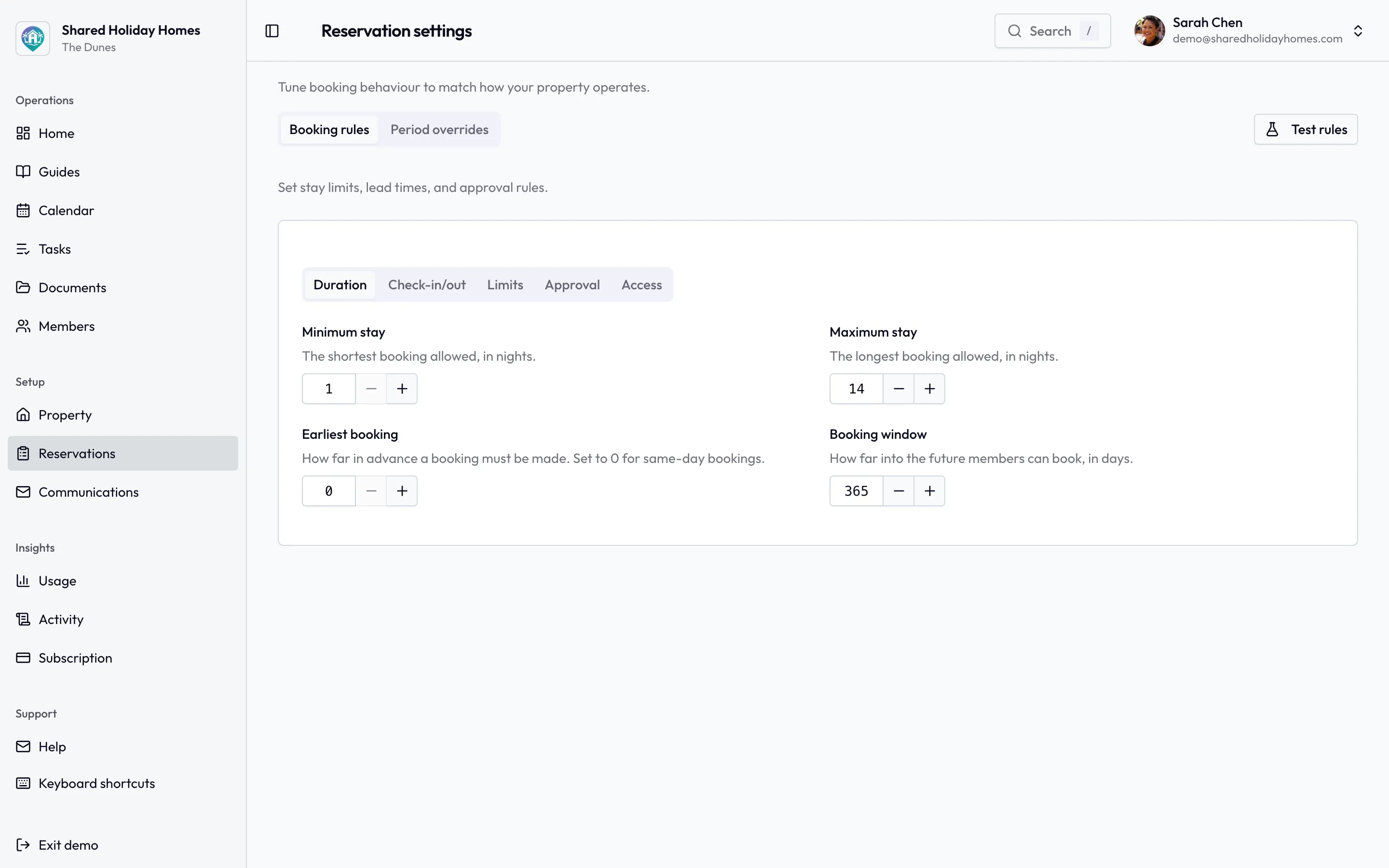
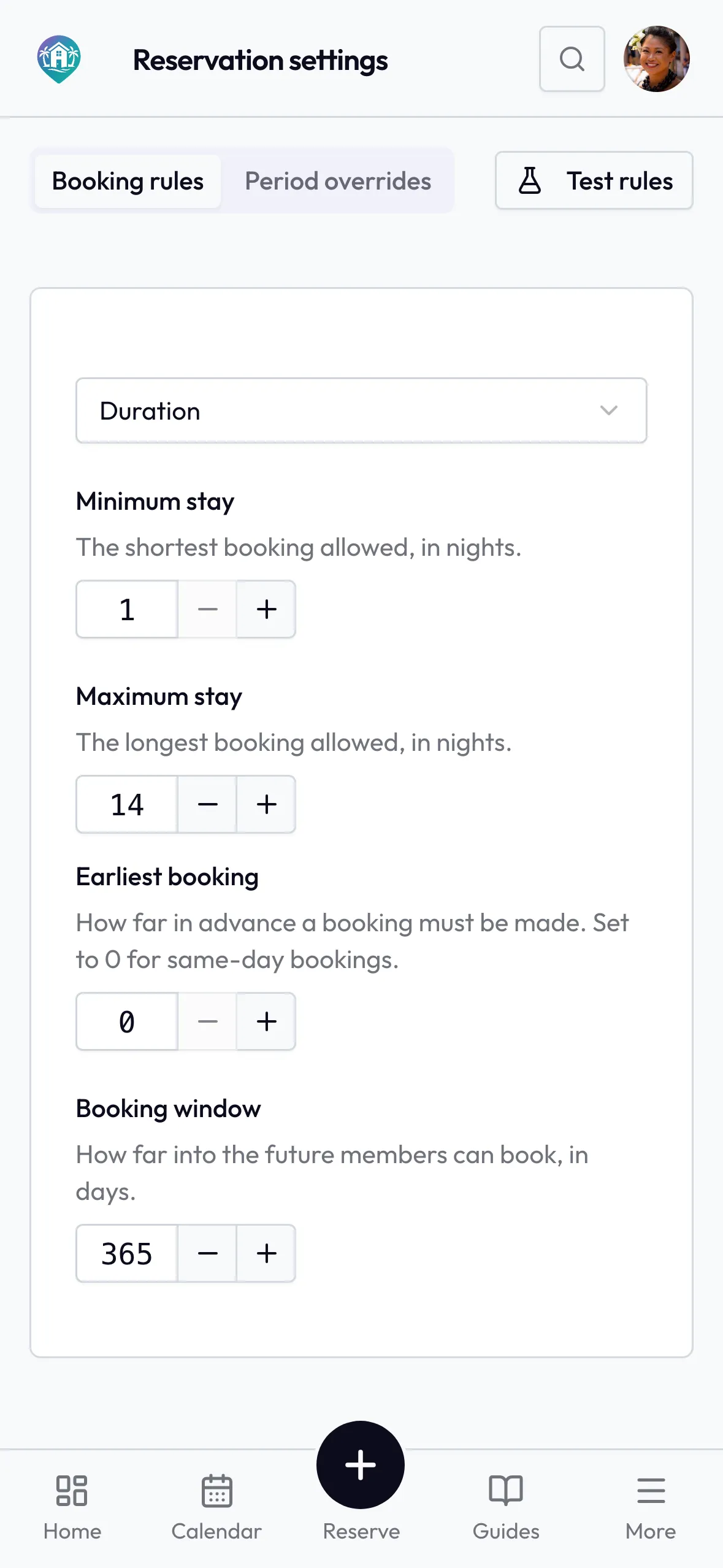
Once the group agrees the 12 decisions, the live calendar should carry the constraints people actually book against.
If the booking policy is part of a wider review covering guests, cleaning, maintenance, costs, and conduct, use the shared holiday home rules generator as a discussion draft. It is not a legal agreement.
Shared Holiday Homes gives an existing private co-owner group one shared booking calendar with configurable stay lengths, lead times, approval, cancellation windows, allowed days, booking limits, and period-specific overrides. The software supports the agreement; it does not create ownership or legal access rights, and broader customs such as annual rotations still need the group’s written policy.
When your group is ready to replace ad hoc booking messages with one visible system, start a Shared Holiday Homes account.

