

Shared Holiday Home First-Season Setup Checklist
A shared holiday home first-season checklist should turn an already-completed ownership setup into one usable operating system. Before the first booking round, give every rule, date, task, cost process, property fact, document, access decision, and guest instruction a current source, an accountable owner, a backup, and a completion test.
This is a post-purchase operating checklist for a private group of family members, friends, siblings, trustees, or other small co-owners. It does not form or transfer ownership, grant trustee or company authority, satisfy a lender or insurer, or replace legal, tax, safety, accessibility, or local-compliance work. Start only when the people responsible for those matters confirm that operating setup may begin.
Copy This First-Season Setup Board
Use the planning windows below as a sequence, not as universal deadlines. A remote home, a long peak-season allocation, building work, or a formal restriction may need more time. Replace each suggested window with the date your group actually needs.
| Planning window | Output | Accountable owner | Complete when |
|---|---|---|---|
| Before operating setup | A written boundary between completed formal work, remaining professional questions, and ordinary coordination | The authorised owner, trustee, representative, or adviser for each matter | The group knows what may begin, what remains restricted, and who can answer each unresolved question |
| About six weeks before use | One setup board, named operating roles and backups, current document index, and first-season decision list | First-season coordinator | Every setup item has a source, status, owner, next action, and test |
| Before collecting shared money | Approved cost categories, contribution dates, evidence route, spending authority, reserve boundary, and private exception route | Budget or cost-record owner | Each household can explain the process and the next due date without receiving data it should not see |
| Before opening bookings | Current booking rules, peak-date method, protected dates, maintenance blocks, cancellation route, and first allocation | Calendar owner | The group can run ordinary, peak, cancellation, swap, guest, and maintenance-block scenarios |
| Before the first arrival | Property-readiness record, approved access, local emergency reference, arrival guide, guest boundary, and open-issue route | Property-information owner with maintenance and access owners | A person who did not prepare the material can find, use, and challenge the current version |
| After each early stay | Short arrival, issue, changeover, consumables, and departure handover | Departing household and named follow-up owner | Every exception is closed, assigned, or visibly carried forward before the next arrival |
| After three meaningful stays | A friction review covering rules, calendar, work, costs, information, access, guests, and handovers | First-season coordinator | Corrections are made in their source systems and larger decisions enter the approved process |
| At season end | A closeout pack for the annual review: evidence, repeated exceptions, unfinished work, next dates, and proposed decisions | Role owners with the annual-review organiser | The next season begins from current records rather than memory or old chat |
Use statuses such as not started, ready to test, blocked, tested, complete, or not applicable. “Discussed” and “sent” are not completion tests. A booking rule is ready when the group can apply it to examples; a document link is ready when the correct audience can open the current version; an access method is ready when it works for an approved holder and is absent for anyone who should not have it.
Set the Boundary Before Setting Up the Season
The first operating meeting should begin with one question: what has already been formally confirmed, and what is still outside this checklist?
Record only the operational answer the authorised source provides. Depending on the group and property, unresolved matters might involve title, a trust or company, lending, insurance, tax, licences, occupancy, fire or electrical safety, accessibility, utilities, or local rules. Give each open question an owner and next date. Do not turn uncertainty into a house rule.
Keep three records separate:
- Formal sources establish rights, duties, restrictions, and professional advice.
- Operating rules explain how the group coordinates within those boundaries.
- Setup tasks make those approved rules usable before the first season.
The vacation home co-ownership guide explains the wider ownership and agreement questions. This checklist starts after that work; it should not be used as evidence that the work is complete.
Name One First-Season Coordinator
Give one person responsibility for the setup board and one backup responsibility for continuity. The coordinator gathers links, schedules tests, records blockers, and confirms handovers. They do not gain extra voting power, spending authority, document access, or control of the property.
Then assign an accountable owner and backup for each operating area:
- booking calendar and allocation rounds;
- budget dates, expense records, and contribution reminders;
- recurring maintenance and open property work;
- approved property and guest information;
- access administration;
- current operating documents;
- meeting records and final decisions; and
- first-season review.
The roles and responsibilities chart separates accountability, task performance, backup, decision route, and handover. Use it before distributing jobs. Otherwise, the most available person can quietly become responsible for everything.
For every role, record the outcome it owns, the source it maintains, the decisions it cannot make alone, the backup, and the event that triggers handover. A title such as “house manager” is too vague unless those boundaries are visible.
Build One Operating Map, Not Another Archive
Create a one-page map pointing to the current source for:
- people, roles, and contact routes;
- approved rules and effective dates;
- confirmed bookings and the next allocation round;
- budget, contributions, expenses, and reserves;
- maintenance schedule, open work, and property restrictions;
- owner, guest, provider, and emergency information;
- approved documents and restricted-document directions;
- physical and digital access administrators; and
- the next review date.
Do not copy full rules, codes, balances, adviser messages, identity data, or maintenance history into the map. A copied field becomes stale while the real source changes. The map should help a co-owner find the answer and identify its owner.
Use the co-owned vacation home management guide to check that the operating areas connect. If two sources claim to be current, make resolving that conflict a setup task before the relevant booking, payment, access, or stay begins.
Prepare the First-Season Budget Before Collecting Money
Start with the allocation rules and obligations the group has already approved. Separate:
- fixed ownership or entity costs;
- shared operating and access costs;
- stay-related costs;
- owner-specific costs;
- planned replacement or reserve contributions; and
- urgent work handled through the approved exception route.
For each expected item, record the source, amount or estimate, evidence date, due date, allocation method, collection owner, approval route, and where the final record will live. Label hypothetical amounts and unconfirmed estimates clearly.
The free cost split calculator can compare equal, ownership-based, usage-based, or custom scenarios with fictional household labels. It does not decide which method the group is permitted or required to use. Keep bank details, tax identifiers, personal affordability information, private arrears, and restricted professional advice out of the shared setup board.
Before the first contribution request, ask each household to explain:
- what the payment covers;
- how its share was derived;
- which evidence is available;
- who may approve spending;
- how an error or private difficulty is raised; and
- what record confirms receipt without exposing unnecessary data.
If the answer depends on a document or adviser, link to the right source or owner. Do not invent a policy to fill the gap.
Agree Booking Rules Before Opening Dates
Do not populate the calendar first and negotiate fairness afterwards. Write the operating rules, test them, then open the first allocation.
At minimum, decide how the group handles:
- ordinary booking windows;
- local or family peak dates;
- overlapping requests;
- maximum active or consecutive bookings;
- protected, blocked, or maintenance dates;
- guests and unaccompanied use;
- changes, cancellations, swaps, and no-shows;
- late availability;
- arrival and departure times; and
- exceptions and the valid decision route.
The free shared holiday home rules generator can create a discussion draft. Compare it with the group's formal and operating sources before approval; a generated draft is not an agreement or professional advice.
Next, use the usage rotation planner to run a fictional peak-season round. Test a tie, a household that cannot use its turn, a cancellation, a maintenance block, and a requested swap. The test is successful when the same facts produce the same result under the written rule and everyone can see what happens next.
Record the rule version and effective date with the first live calendar. Avoid keeping one rule in a document and a different one in old group messages.
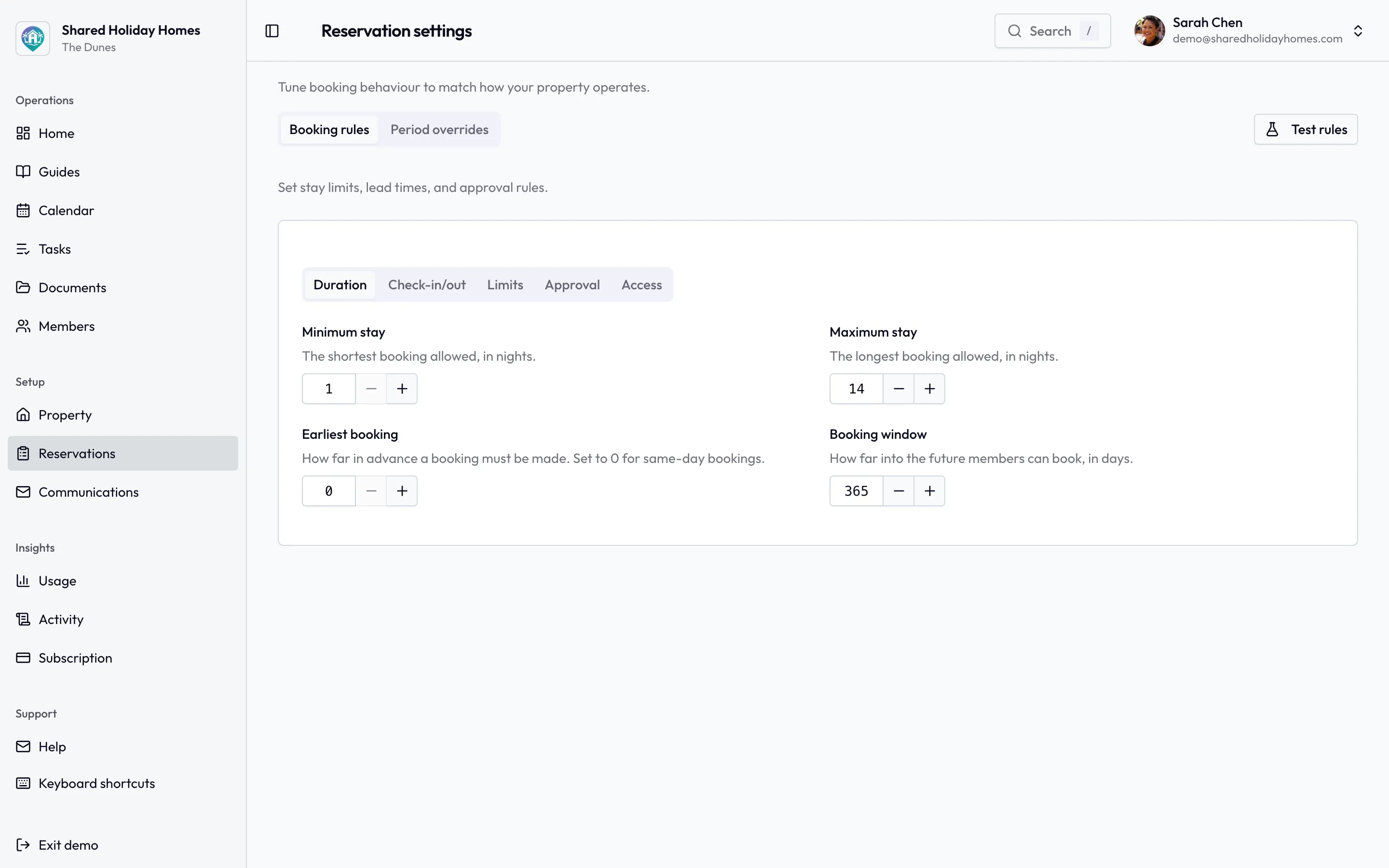
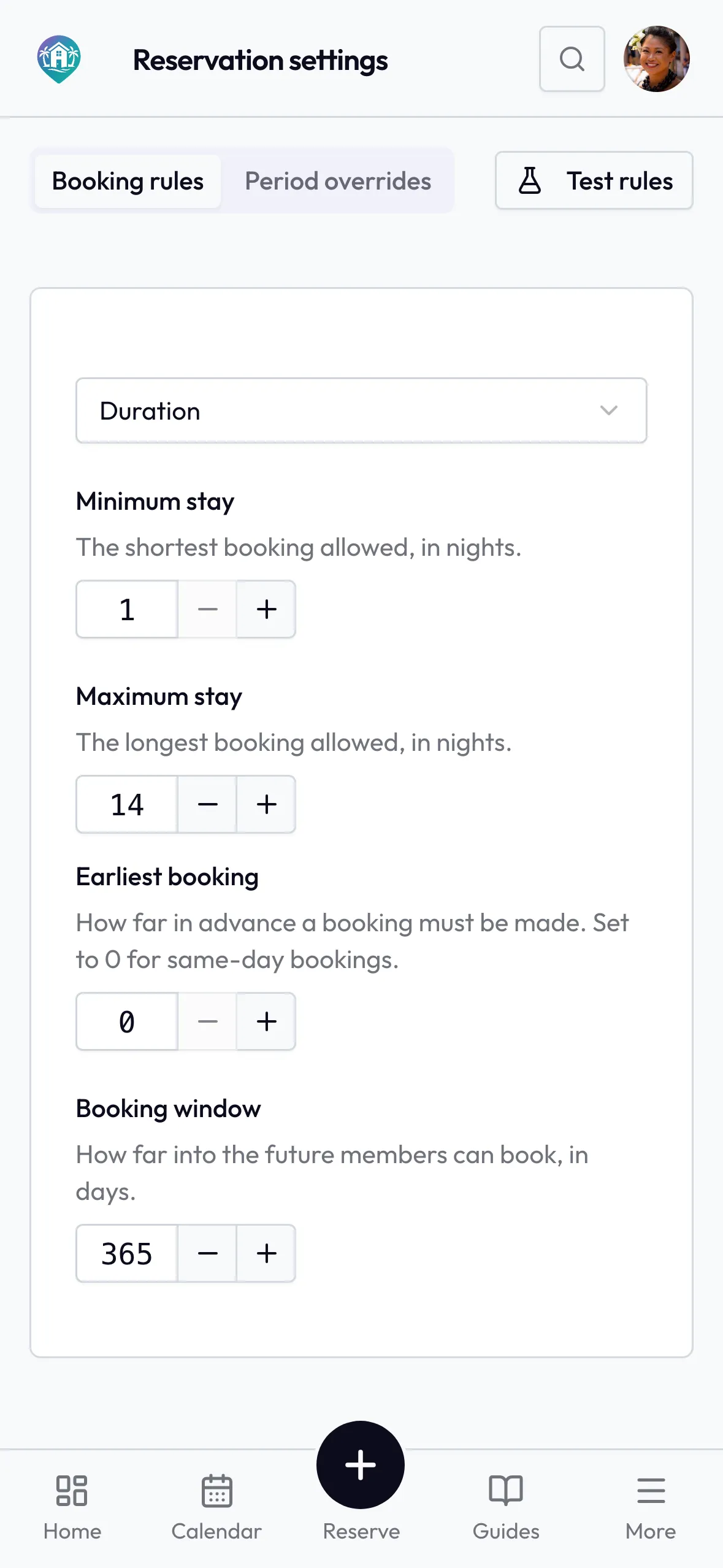
Open dates only after the live calendar carries the stay lengths, lead times, and approval rules the group just agreed.
Make the Property Ready for People, Not Just Bookings
Calendar availability does not prove the home is ready to occupy. Before the first arrival, assemble a property-specific readiness record using current manuals, qualified assessments, providers, local authorities, and the group's approved sources.
Cover:
- known restrictions or incomplete work;
- recurring tasks due before or during the season;
- utilities, appliances, waste, water, heating or cooling, and other property systems;
- provider access and escalation routes;
- arrival, parking, departure, and changeover instructions;
- current local emergency contacts and meeting information; and
- the person who can update each field.
Use the free maintenance schedule to draft recurring work from the property's own sources. Do not copy universal service intervals into the checklist or ask an unqualified co-owner to diagnose specialist work.
Emergency information must be verified for the exact property location. As one U.S.-specific planning example, Ready.gov's family emergency communication plan uses a collect, share, and practise sequence for contact and meeting information. Use the relevant local authorities and professional sources for your home; do not assume U.S. numbers or procedures apply elsewhere.
Separate Owner Access From Guest Information
Prepare access by audience and purpose rather than putting every key, code, account, and file into one welcome message.
Review these layers separately:
- ordinary owner property access;
- time-limited guest instructions;
- provider or contractor access;
- backup and emergency access;
- shared calendar, task, property-information, and document permissions;
- administrator rights; and
- restricted formal, financial, identity, insurance, or professional records.
For each layer, identify who authorised it, who administers it, when it begins, how it is tested, and what triggers return, review, or removal. The checklist can point to the controlled location of a secret; it should not duplicate the secret itself.
Keep the guest guide narrower than the owner operating map. Guests need the approved information for their stay, not ownership records, other households' bookings, private contact details, alarm administration, full maintenance history, or financial files.
Rehearse One Stay Before the First Live Arrival
Run a fictional stay from request to departure. Ask a household that did not prepare the setup material to:
- find an eligible date and apply the booking rule;
- identify a restriction or maintenance block;
- locate the approved arrival and property information;
- explain the guest and access boundaries;
- find the route for an urgent property issue;
- record a non-urgent observation without diagnosing it;
- locate the changeover standard; and
- hand over an unresolved item to the next accountable person.
Fix the source when the test fails. Do not blame the tester for a stale link, ambiguous label, missing permission, contradictory rule, or hidden task.
For the first live stays, use a short handover with four outcomes: ready, ready with a visible exception, blocked, or follow-up assigned. A photo or message alone is not a closed task unless the agreed record shows who owns the next action and when it will be reviewed.
Review Friction After Three Meaningful Stays
“Three stays” is a useful prompt, not a universal threshold. Choose the first cycle that includes enough real activity to test the system: perhaps a peak booking, a contribution date, a guest visit, a maintenance handover, or a changeover between households.
Ask:
- Which booking rule needed interpretation?
- Which role had no owner, backup, or decision boundary?
- Which payment, expense, or reserve field was unclear?
- Which task arrived too late or lacked evidence?
- Which property instruction was missing or stale?
- Which access was too broad, too narrow, or not tested?
- Which guest instruction exposed too much or too little?
- Which handover left work invisible to the next household?
Correct facts, links, permissions, and tasks in their source systems. Put policy changes through the approved decision process. Do not quietly rewrite a rule because one stay was inconvenient, and do not turn a repeated exception into a permanent custom without review.
Worked Example: Four Households Prepare Their First Summer
Four siblings have completed the relevant ownership and professional setup for a coastal home. The authorised family representative confirms that operating setup can begin while one insurance question remains with the broker. The group records that question and does not claim the checklist answers it.
Sam coordinates the first-season board and Lee is backup. The roles chart names owners for the calendar, cost records, maintenance, property information, documents, and access. Each role points to a current source and states which decisions need wider approval.
The group tests a six-week planning sequence. Before collecting money, it records recurring operating costs, a separate reserve contribution already approved by the group, evidence dates, due dates, and the private route for a payment question. The calculator uses Household A through D; no bank details appear on the board.
Before opening summer dates, the siblings test one peak-week collision, a cancellation, and a maintenance block. The written rule produces a clear allocation and shows when an unused week returns to the pool. The calendar owner records the rule version beside the first allocation date.
The maintenance owner confirms current property work from local sources and assigns a provider-access window. The property-information owner verifies arrival, waste, utility, and local emergency details. Owner access is tested separately from the guest guide.
After the first three stays, the group finds two issues: the departure guide does not say where to record a low-priority appliance problem, and the booking rule does not explain a same-week swap. The information owner fixes the reporting route. The swap question enters the approved decision process rather than being settled in chat. Both changes keep their source and effective date.
FAQ
What should co-owners organise before their first shared season?
Confirm the formal boundary, then set operating roles, current sources, cost collection, booking rules, maintenance readiness, property information, access, guest guidance, handovers, and a review. Give every item an owner, backup, date, and completion test.
Is six weeks enough to set up a shared holiday home?
It is only a planning example. The right lead time depends on the property, group, booking cycle, local requirements, provider availability, formal restrictions, and unresolved work. Start earlier when a real source or qualified person says more time is needed.
How is this different from onboarding a new co-owner?
First-season setup prepares the whole group's operating system after ownership setup. New co-owner onboarding introduces one approved participant to an established system. If a person joins later, use the separate onboarding process rather than reopening every first-season decision automatically.
Should the checklist include passwords, access codes, or bank details?
No. Record the audience, purpose, administrator, controlled location, test, and review trigger. Keep secrets and private financial or identity data in an appropriately restricted system, not in a broad checklist or group message.
What if the home is already booked before the setup is complete?
Do not hide the gap. Identify the affected stay, restriction, source owner, next action, and decision route. Pause or change the booking when the authorised rule or safety source requires it. A busy calendar is not evidence that the home is ready.
Is Shared Holiday Homes a property manager or fractional marketplace?
No. Shared Holiday Homes is coordination software for families, friends, siblings, trustees, and small groups already sharing or jointly owning a private holiday home. It does not sell shares, form the ownership arrangement, manage the property, or replace professional advice.
Make the First Season Easier to Run
Shared Holiday Homes can keep shared bookings, assigned tasks, property information, and approved house documents visible in one workspace. The value of the setup still comes from the group's real rules, sources, permissions, and follow-through.
Start a free trial when the group is ready to coordinate its first season without rebuilding the plan from chat.


