

Shared Holiday Home Annual Review Meeting Agenda
A shared holiday home annual review should turn the past year's booking, cost, maintenance, guest, and document records into a small set of decisions and named actions for the next year. Use the 60-minute agenda below, send a fact pack before the meeting, and record each outcome as either a decision, an action, a question for qualified advice, or an item that stays unchanged.
The meeting is for operating the home, not rewriting legal rights in an hour. Follow the decision rules in the group's deed, trust, entity documents, co-ownership agreement, or other governing records. Put tax, insurance, ownership-transfer, valuation, lending, safety, employment, and local-law questions into a separate advice list for the appropriate qualified professional.
Prepare a Short Pre-Read Pack
The meeting works better when co-owners review the same evidence before discussing solutions. One coordinator can assemble the pack, but the underlying information should come from the group's approved records rather than memory or a busy message thread.
Keep it short enough to scan. Include exceptions and changes, not every routine transaction.
SHARED HOLIDAY HOME ANNUAL REVIEW — PRE-READ

MEETING
Date and time:
Facilitator:
Note-taker:
Decision method from the governing agreement:
People unable to attend and how their input will be handled:

BOOKINGS AND ACCESS
Current booking policy and version:
Peak dates requested for the next cycle:
Unfilled or repeatedly disputed dates:
Cancellations, swaps, guest stays, or exceptions to review:
Known maintenance blocks or owner constraints:

COSTS AND RESERVES
Approved budget versus recorded spending:
Unpaid or unreconciled items:
Known recurring-cost changes:
Open repair quotes and planned replacements:
Current reserve balance and restrictions, if applicable:

MAINTENANCE AND PROPERTY CONDITION
Emergency and urgent items:
Overdue or repeatedly reopened tasks:
Completed work needing final records:
Next seasonal and professional service dates:
Property-specific instructions needing verification:

GUESTS, RULES, AND DOCUMENTS
Recurring guest or changeover exceptions:
Rules proposed for review:
Welcome-book or emergency-sheet fields that changed:
Important documents missing, superseded, or due for review:

PROPOSALS
Decision requested:
Reason and supporting record:
Options considered:
Who is affected:
Required source or professional advice:
Set a clear cut-off for additions so owners can read the final pack. If a proposal arrives too late to assess safely, record it for follow-up instead of forcing a decision during the meeting.
Copy This 60-Minute Annual Review Agenda
The times are a facilitation guide, not a rule. A smaller group with current records may finish sooner; a complicated issue may need its own later meeting.
| Time | Agenda item | Required output |
|---|---|---|
| 0–5 minutes | Confirm scope, decision method, facilitator, note-taker, and the outcomes needed today. | An agreed agenda and a visible advice or parking list. |
| 5–12 minutes | Correct the pre-read facts. Note missing records without debating solutions yet. | One accepted fact base and owners for missing information. |
| 12–22 minutes | Review bookings, fair access, peak dates, cancellations, guests, swaps, and maintenance blocks. | Dates or booking rules to keep, change, test, or verify. |
| 22–32 minutes | Review recorded costs, next year's operating plan, contribution timing, reserves, and approval limits. | A draft operating budget and a list of finance or advice questions. |
| 32–42 minutes | Review property condition, overdue work, recurring tasks, planned replacements, and specialist services. | Prioritised work with a named owner and next date. |
| 42–50 minutes | Review guest information, house rules, emergency details, and the approved document set. | Specific content to update, retire, verify, or leave unchanged. |
| 50–57 minutes | Read back proposed decisions and apply the group's existing approval method. | Final wording, effective dates, dissent or abstention where required, and superseded versions. |
| 57–60 minutes | Assign follow-up, review triggers, and the next check-in. | An action list whose every item has one owner and one due date. |
Do not let the first unresolved topic consume the whole hour. Capture what is missing, name the person who will obtain it, and move on. The aim is not to compress every disagreement into one meeting; it is to leave each operating area in a known state.
Prepare the finance section with the shared holiday home annual budget template, which connects each recurring cost, planned-work line, reserve contribution, due month, source date, owner, and variance review without replacing the group's valid allocation rules.
Give Every Topic One of Four Outcomes
“We discussed it” is not an outcome. Mark each agenda item as one of these:
- Keep: the current rule or process still works, so record that it was reviewed and remains in force.
- Change: the group approved exact replacement wording, an effective date, and any treatment of existing bookings or commitments.
- Act: no policy change is needed, but a named person must complete a task by a date.
- Verify: the group needs a document, quote, inspection, insurer response, or qualified professional answer before deciding.
Keep “decision” and “action” separate. A decision might be “peak requests will open on 1 October under the existing rotation.” Its actions might be “Alex enters the allocation by 5 October” and “Morgan uploads the approved policy version.” One records what the group agreed; the others record work still to be done.
For every final decision, capture:
- the question decided and the exact wording;
- which property, dates, people, or costs it covers;
- the approval route used and the recorded result;
- when it takes effect;
- the rule or version it replaces;
- any linked task, document, or calendar change; and
- the next review date or earlier review trigger.
That decision record should remain concise. The holiday home communication playbook explains why approved outcomes should live outside scattered chat. The annual agenda is the process for reviewing the whole operating system once, not a replacement for ongoing records.
Review Booking and Fair Use Without Rewriting the Whole Policy
Start with visible exceptions: overlapping peak requests, dates that went unused, recurring late cancellations, repeated swaps, guest uncertainty, and maintenance work displaced by stays. The calendar can show what happened, but it cannot decide what the group considers fair.
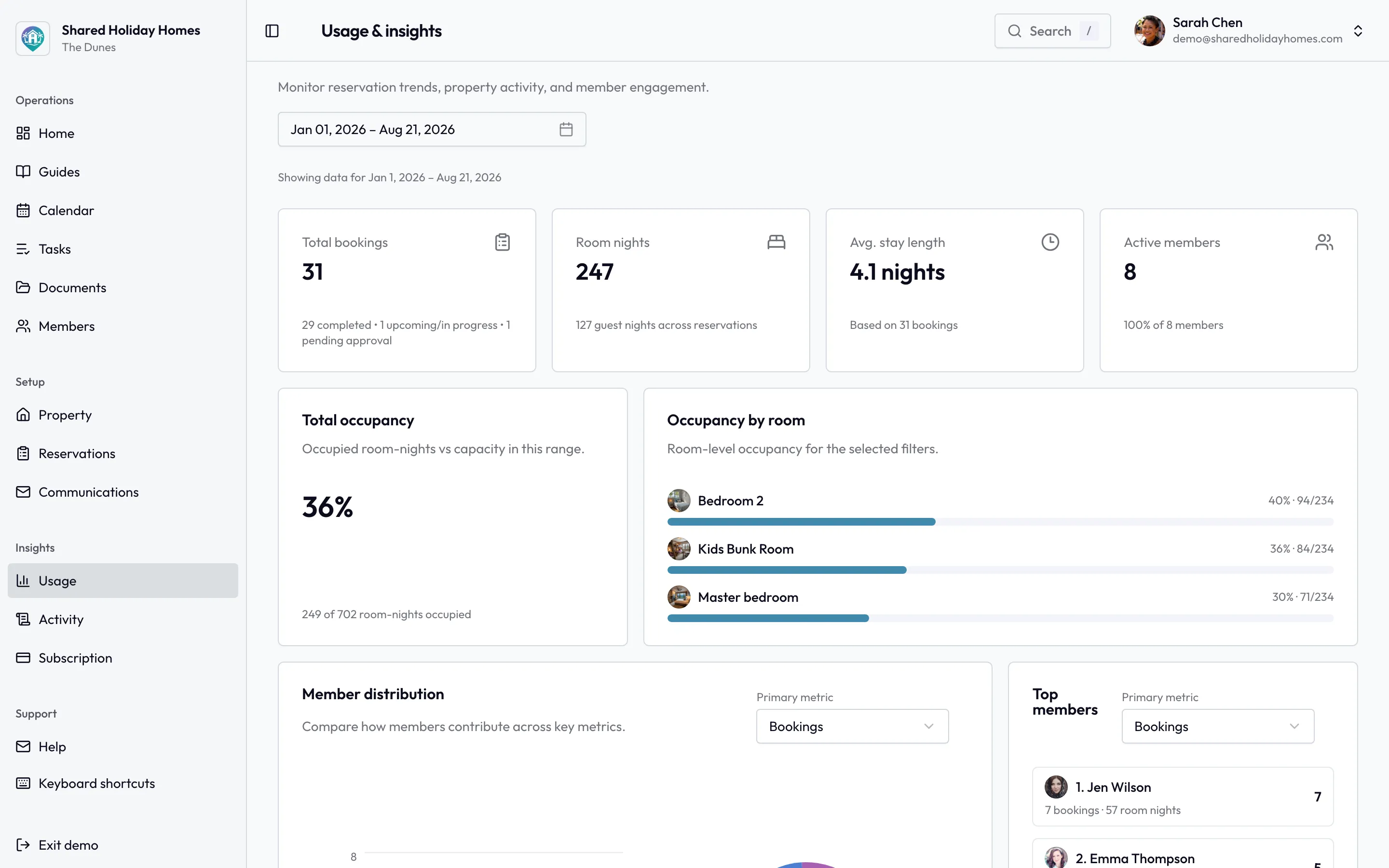
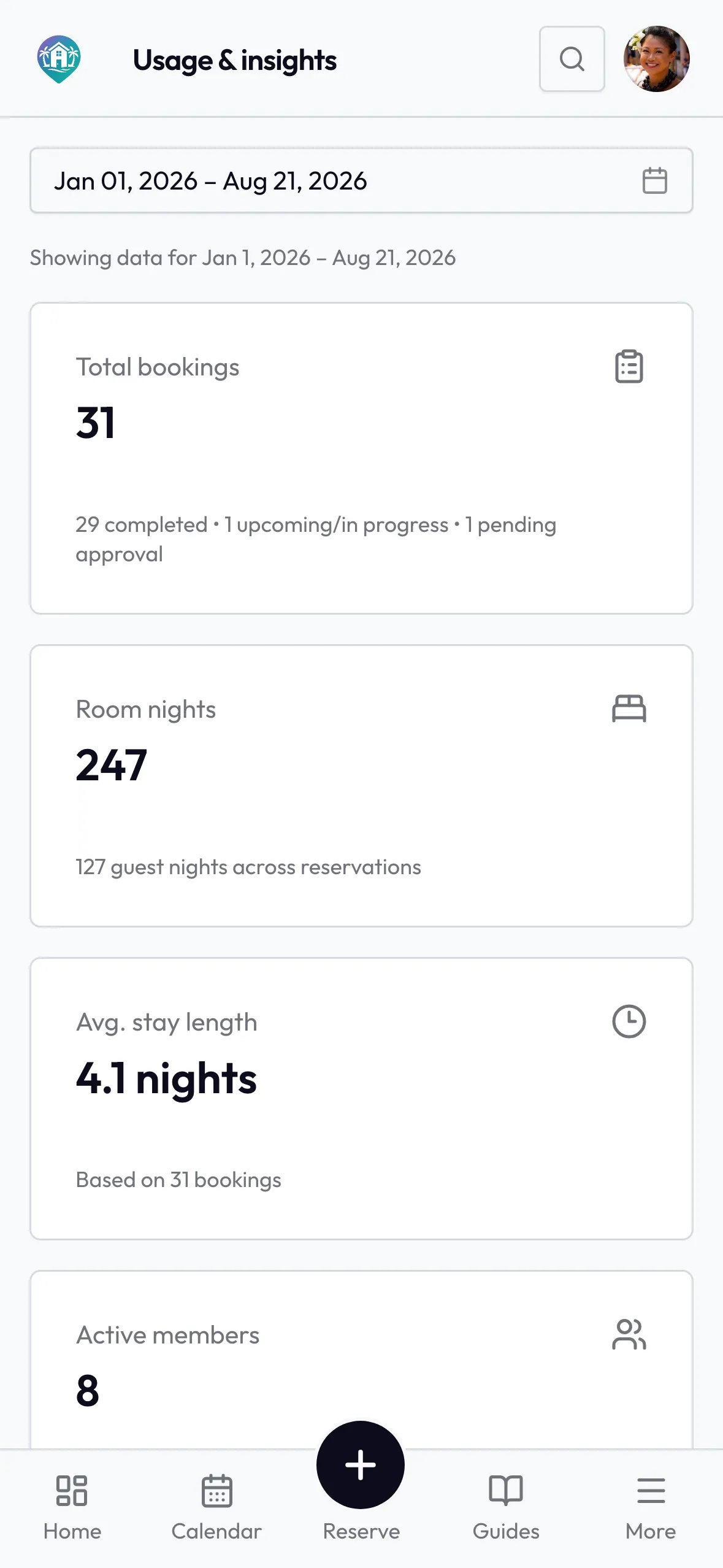
Bring a shared usage baseline to the meeting so the group reviews next year’s rules instead of reconstructing last year’s nights.
Use the 12-decision vacation home booking policy for the underlying rules. During the annual review, ask only:
- Did the agreed booking method operate as written?
- Which real scenario exposed an ambiguous rule?
- Did one exception solve a rare case, or reveal a repeatable gap?
- Which confirmed bookings must be protected from a policy change?
- What peak dates and maintenance blocks must be planned next?
If the group wants to compare peak-date allocation methods before deciding, use the free usage rotation planner with fictional household labels. Treat its output as a discussion draft, then apply the approval requirements in the group's own governing documents.
Review Costs as Categories, Records, and Decisions
Do not use the meeting to reconstruct a year of missing receipts. Reconcile the record beforehand and bring only exceptions, changes, and decisions into the agenda.
Review:
- actual operating costs against the approved plan;
- recurring expenses that changed or no longer apply;
- unpaid contributions and unreconciled reimbursements;
- repairs or replacements likely to affect the next cycle;
- the current reserve record and any limits on its use; and
- who may approve routine, urgent, and unbudgeted spending.
The shared vacation home expense guide separates ownership, equal-access, stay-related, owner-specific, and reserve costs. The free cost split calculator can compare allocation methods without collecting names, addresses, or bank details.
An operating review is not a tax return, valuation, loan decision, or legal settlement. If a proposed change affects legal obligations, ownership percentages, regulated accounts, tax treatment, insurance cover, or someone's ability to remain an owner, stop and obtain appropriate independent advice.
Turn Maintenance History Into the Next Plan
The maintenance discussion should answer three questions: what is unsafe or urgent now, what is due before the next busy period, and what evidence changes the longer-term plan?
Bring the current vacation home maintenance log, not a collection of unlabelled photos and chat messages. Review overdue work, repeat failures, open quotes, incomplete completion evidence, the next service date for important systems, and access windows for qualified trades.
Then connect the findings to the maintenance checklist for co-owners. Use the free maintenance schedule to draft property-specific recurring work, removing anything irrelevant and verifying tasks against local requirements, insurer conditions, manufacturer instructions, and qualified professional advice.
Do not vote that an electrical, structural, fire, gas, water, medical, or other safety issue is “probably fine.” Record the observation accurately, restrict unsafe use where appropriate, and refer it to the relevant emergency service or qualified local professional.
Review Guest Information, Rules, and Documents
This part is not a line-by-line reading of every file. Look for contradictions, old versions, access that is too broad, and information that no longer matches the property.
Ask:
- Do current house rules match the approved booking and guest policy?
- Does the guest welcome book still match access, Wi-Fi, appliances, arrival, and departure arrangements?
- Has each field in the emergency information sheet been verified for the property's location?
- Is the current file clearly distinguishable from drafts and superseded copies?
- Can members find the approved documents they need, while private access codes and personal information remain appropriately restricted?
- Does each important record have an owner and a change-based review trigger?
The annual meeting is a backstop, not permission to leave information stale for a year. Review emergency, access, provider, insurance, ownership, and property-condition information as soon as the relevant fact changes.
Use a Fair Meeting Process
A useful agenda does not create decision authority. Before the meeting, confirm who may decide, which people must be present or consulted, how conflicts are handled, and whether written consent is required. Those rules come from the group's valid governing documents and applicable law, not from this template.
Practical facilitation helps the group use that authority clearly:
- circulate the same final pre-read to everyone;
- let absent owners submit input through the agreed route;
- state the decision question before debating options;
- ask people to identify interests and constraints, not speculate about motives;
- distinguish a request for more evidence from a veto;
- read final wording aloud before recording approval; and
- do not record silence as consent unless the governing process expressly allows it.
If a conflict affects relationships or legal rights, use the dispute process already agreed and seek independent help where appropriate. Software can keep records visible; it cannot make a disputed decision valid.
Worked Example: Four Co-Owners Review One Year
This fictional example shows the record structure, not a recommended outcome.
Four households privately share a coastal cottage. Their pre-read shows three recurring booking swaps, an exterior repair awaiting a second quote, a higher insurance renewal, two overdue maintenance tasks, and an emergency sheet that still names a former local contact.
During the meeting they record:
| Topic | Outcome | Next record |
|---|---|---|
| Booking swaps | Verify: the group wants examples of how a proposed cut-off would affect confirmed dates. | Jamie models three scenarios for a separate decision next week. |
| Exterior repair | Act: no contractor is selected until the comparison and authority check are complete. | Riley obtains the second quote and confirms the approval route. |
| Insurance renewal | Verify: cost and cover questions go to the broker rather than being guessed in the meeting. | Sam records the broker's written response beside the current policy. |
| Overdue tasks | Act: one task is reassigned; the other awaits qualified inspection. | Both tasks receive one owner, one due date, and a visible status. |
| Emergency contact | Change: the unverified contact is removed immediately. | Taylor verifies the replacement through the relevant official or provider source before publishing it. |
The group did not “solve” the repair, insurance, and booking questions during the hour. It did remove ambiguity: each issue now has a status, evidence requirement, owner, and next date.
Close the Loop After the Meeting
Send the draft record promptly while the wording is still easy to check. Follow the group's existing process for corrections, signatures, written consents, or approval. Do not quietly edit a final decision after circulation.
Complete this close-out checklist:
- Publish the agreed decision wording and effective dates.
- Mark replaced rules and documents as superseded without deleting required history.
- Add approved peak dates and maintenance blocks to the shared calendar.
- Create each follow-up task with one accountable owner, a due date, and a clear definition of done.
- Store the approved files where authorised members can find them.
- Restrict personal, access, financial, and professional records to the people who genuinely need them.
- Schedule the next routine check and every earlier trigger identified during the review. Use the shared holiday home admin calendar template to keep each non-booking source date, preparation start, owner, backup, and completion record visible between annual meetings.
Use the shared holiday home decision log template to preserve the final wording, approval route, effective date, superseded rule, follow-up, and review trigger for each outcome. Keep the meeting record as evidence of the session rather than making it the only place the current rule can be found.
An annual review cannot carry the entire operating system. Use shorter check-ins for urgent repairs, approaching peak dates, budget exceptions, overdue actions, and information changes.
FAQ
What should co-owners cover in an annual holiday home meeting?
Cover booking and access, costs and reserves, maintenance and property condition, guest information and house rules, important documents, open decisions, and named follow-up. Use records from the past year and finish with exact outcomes rather than broad discussion notes.
How often should a shared holiday home be reviewed?
An annual cross-area review is a practical backstop, not a universal or sufficient cadence. Review urgent work immediately and revisit a rule when its stated trigger occurs—for example, after a disputed peak season, material cost change, ownership change, insurance update, new hazard, provider change, or repeated exception.
Who should chair the meeting?
Choose someone who can protect the agenda, state decisions neutrally, and separate unresolved evidence from debate. The facilitator does not gain extra authority by chairing. A different person should capture the exact record when practical.
What if one co-owner cannot attend?
Use the notice, quorum, consent, proxy, or consultation process in the group's valid governing documents. Share the same pre-read, collect the person's input through the approved route, and do not assume absence means agreement.
Should trustees or an entity manager use this agenda?
They can use the operating topics as a preparation checklist, but their duties and authority may differ from those of individual co-owners. The relevant trust, entity, title, and local-law requirements take priority, and qualified advice may be necessary.
Is this agenda for commercial fractional ownership or timeshares?
No. It is written for a private group—such as family, friends, siblings, trustees, or a small owner group—already sharing or jointly owning a particular holiday home. A provider-managed fractional product or timeshare has its own contracts, management powers, fees, use rights, and exit processes.
Make Next Year's Review Easier
Start with the pre-read, choose the decisions the group genuinely needs, and leave every unresolved item with an evidence requirement, owner, and next date. The meeting is successful when the next year's operating plan becomes visible—not when every topic fills the hour.
Shared Holiday Homes gives an existing private group one place for its booking calendar, tracked tasks, and house documents. If those records are currently scattered, start a free trial and build next year's review from information the group can actually find.


